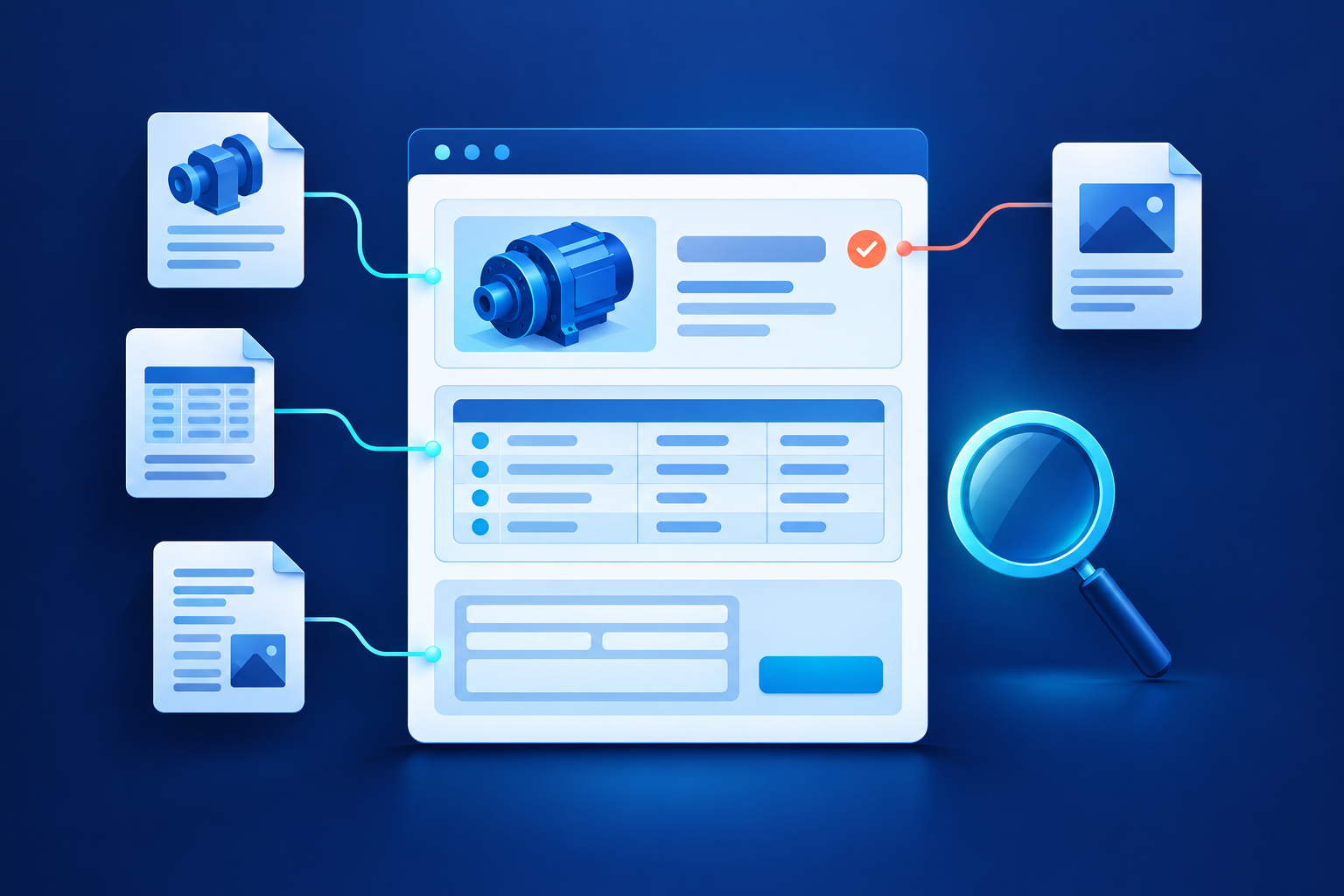
Before buying an AI-visibility package, check whether your website answers the questions customers need resolved. Useful AI search website content starts with what you supply, who it suits, where your capabilities stop and what a buyer should send next. Spend first on missing facts and genuine discovery barriers—not a promise of citations.
1. Understand what official guidance does—and does not—say
Google's people-first guidance asks whether content provides original information, clear sourcing and enough substance to help visitors achieve their goal. Its generative AI optimisation guide likewise prioritises useful, non-commodity content over generic summaries. These are Google-specific statements, not a description of every AI provider's source-selection process. [1][3]
Softglimmer's practical recommendation is to improve customer information first. The worksheet and sequence below are planning tools, not documented search requirements. Their purpose is to make information accurate, findable and usable without depending on changing platform controls.
2. Audit unanswered buying questions
Choose one important product or service page. Ask sales and operations which questions delay quotations, cause unsuitable enquiries or need repeated explanation. Consult recent messages without copying personal details into the worksheet. Include limitations and exclusions, not just benefits.
| Customer question | Current answer | Supporting evidence | Responsible owner | Next action |
|---|---|---|---|---|
| Can you meet this requirement? | Broad capability claim | Approved capability record | Operations lead | Publish confirmed scope and limits |
| Is this suitable for my use? | Benefits without exclusions | Approved suitability guidance | Product or service lead | Explain fit and when advice is needed |
| What should I send for a quote? | Contact us | Actual quotation process | Sales lead | List required inputs beside the enquiry route |
| Can you deliver here and when? | Unqualified delivery promise | Current delivery policy | Delivery lead | State conditions and what needs confirmation |
| Does this certification cover the work? | Badge without scope | Current certificate and scope | Quality lead | Publish only the applicable claim |
Use actual page wording in the current-answer column. Record the evidence location internally, assign one accountable owner and give each next action a deadline. Prioritise a gap that affects buying suitability or quotation preparation. If evidence is missing, narrow or remove the claim rather than polishing it.
3. Check discovery access before a content overhaul
Ask a developer to check important public pages for internal links, readable essential text and unintended crawler blocking by the website or hosting infrastructure. Google's AI-features documentation identifies these as relevant foundations and says structured data should match visible page text. [2]
Keep the request focused: identify affected pages, the barrier and the proposed fix. Crawling means a service can visit a page; indexing means a search engine includes it in its searchable collection. Neither should be confused with being selected for an AI answer. Preserve deliberate restrictions on confidential or private information.
For ChatGPT search crawler access, OpenAI distinguishes OAI-SearchBot, used for search, from GPTBot, used to crawl content that may support model training. Their settings are independent: a site can allow OAI-SearchBot while disallowing GPTBot. OpenAI recommends allowing its published search-crawler IP ranges as well as the appropriate robots.txt access. [4]
Treat search access and training permission as separate business decisions. Do not purchase training access as a placement tactic. Ask for a documented access policy and a check that firewall rules implement it; an access change is not evidence that a page will receive citations.
4. Make essential information accessible to people
Put essential capabilities, conditions and quotation inputs in page text rather than only in a brochure image. W3C's Page Structure Tutorial explains how meaningful structure and headings support navigation. Its Images Tutorial distinguishes informative images, which need suitable text alternatives, from decorative images, which generally need empty alternatives. [5][6]
- Use descriptive headings that follow a logical hierarchy.
- Present specifications as readable text and tables with clear headers and units.
- Describe useful image information; do not fill alternative text with keywords.
- Test enquiry labels, keyboard operation and submission feedback, including on mobile.
- Offer a reviewed local-language version where customer needs justify it.
This is not a complete accessibility audit or a proven AI-ranking technique. Test a customer task: find a scope limit, understand it and submit the required enquiry details. Accessible business website content should help people complete that task, not merely look tidy.
5. Ground important claims in evidence
Build a simple claim register alongside the worksheet. Match materials and dimensions to approved specifications, capabilities to operations records, certifications to current scope documents and delivery conditions to policy. For customer examples, require verified facts and publication permission. Keep confidential evidence internal while publishing the useful boundary.
Google's generative AI content guidance says to manually fact-check and review AI-generated content before publication. It explicitly extends that review to titles, meta descriptions, structured data and image alternative text. It also warns that generating many pages without added user value may violate its scaled content abuse policy. [7]
Our recommended workflow is to supply approved facts, mark unsupported statements, obtain approval from the responsible business owner and record a review date. Use AI to organise material, not authorise claims. When timing or availability varies by order, explain the confirmation process instead of inventing an estimate.

6. Hypothetical example: a Pune quotation page
Assume a Pune sheet-metal SME seeks enquiries from equipment manufacturers. This is an invented planning scenario, not a client account or a measured result. Its page says “outstanding fabrication for every industry” but provides no usable scope. The proposed replacement would publish only capabilities the business can substantiate.
| Section | Information to gather | Approval needed |
|---|---|---|
| Capabilities | Actual processes and confirmed limits | Operations |
| Materials | Supported materials and constraints | Approved capability records |
| Scope boundaries | Included, excluded and outsourced work | Sales and operations |
| Quotation inputs | Drawing, material, quantity, finish and destination | Sales confirms what is required |
| Evidence | Relevant photographs and factual project details | Fact verification and publication permission |
No machinery, tolerances, dimensions or turnaround promises have been invented. The proposed page gives buyers a preparation route and identifies matters needing discussion. Its value does not depend on an AI service selecting it.
7. Challenge AI optimisation claims before paying
On llms.txt and Google Search, Google's optimisation guide says Search ignores these files: they neither help nor harm visibility or rankings. The same guide says there is no required tiny-chunk format, ideal page length, special AI writing style or special schema.org markup. It also cautions against inauthentic mentions. These positions concern Google Search. [3]
- Which named search system consumes the proposed file or markup?
- What primary documentation supports its purpose?
- Why does this answer need a prescribed length or separate page?
- What credible evidence supports the claim beyond selected screenshots?
- Are proposed mentions authentic, relevant and authorised?
- What deliverable remains useful if the promised citation never appears?
Require concrete deliverables such as corrected claims, accessible specifications or resolved access barriers. Treat guaranteed citations and ranking promises as warning signs. A supplier can commit to completing work; that is different from controlling a provider's source choices.
8. Prioritise useful work and measure cautiously
- Choose one recurring buying question with sales and operations.
- Record the current answer and missing quotation details.
- Approve the evidence, boundaries and page owner.
- Publish the improved answer and accessible enquiry route.
- Request focused discovery checks on the affected pages.
- Review enquiry usefulness and update facts when operations change.

Track suitable enquiries, quotation completeness and recurring misunderstandings using consistent definitions. Compare similar periods and note other changes, such as advertising or seasonality. Referral data and customer-reported discovery routes can provide clues, but neither proves every enquiry's origin. One observed AI answer does not establish sustained visibility or commercial returns.
Does my website need a special AI writing format?
Google's optimisation guide says no special writing style is needed for its generative AI search features. Organise answers for your customers rather than a prescribed AI format. [3]
Can we allow ChatGPT search crawling but disallow training crawling?
Yes. OpenAI documents independent OAI-SearchBot and GPTBot settings. This separates the crawler permissions; it is not a citation guarantee. [4]
What should a limited website budget fund first?
Start with the most consequential information gap or genuine discovery barrier. Complete one worksheet, approve the facts and improve the page before commissioning a broad AI-visibility package.
Sources & further reading
Use the original guidance when checking details or planning implementation.
- Google: Creating helpful, reliable, people-first content ↗
- Google: AI features and your website ↗
- Google: Optimizing your website for generative AI features on Google Search ↗
- OpenAI: Overview of OpenAI crawlers ↗
- W3C WAI: Page Structure Tutorial ↗
- W3C WAI: Images Tutorial ↗
- Google: Guidance on using generative AI content on your website ↗
This research-assisted guide uses the primary sources linked above. Examples are illustrative unless explicitly identified otherwise. Check original documentation when implementing changes.