Find the right starting point
Review the task with the people who do it today. Compare clearer content, ordinary search, fixed rules and AI assistance. The choice should follow the work and the available material.

Softglimmer helps London businesses plan and build practical AI assistance around a clear task. The work can range from finding approved information to helping staff review documents or prepare a useful draft. We assess the material, design the experience, build the selected pilot or integration and review how it behaves. Delivery is remote from our Ranchi studio, with your team supplying the business knowledge and decisions.
Start with the people, information and result that would help them.
Connect the selected sources to an understandable interface and review step.
Review realistic examples and give ongoing ownership a clear home.
An example journey, shaped around your requirements.
An information search tool, an enquiry assistant and a document-review aid serve different users. We help define the useful task first, then assess the sources and design a focused implementation around it.
Review the task with the people who do it today. Compare clearer content, ordinary search, fixed rules and AI assistance. The choice should follow the work and the available material.
The selected scope can include source preparation, retrieval, prompts, a review screen or conversation, and connections to approved applications. Users should be able to understand the result and find the context they need.
Use representative material to assess useful results, mistakes and questions needing another route. Agree source updates, user access, provider accounts, usage review and who receives a problem after handover.
Start from the permitted document or information.
Present a useful result with its context.
Let the responsible person confirm or correct it.
Illustrative assistance journey. The chosen task determines its sources and review steps.
Some tasks need an exact lookup or an agreed calculation. Others benefit from interpreting varied wording or preparing a draft. We can combine the suitable parts while keeping their purposes understandable.
Name the approved sources, their owners and which users may see them. A reviewed source set is more useful than connecting every available file without knowing who maintains it.
Design the result around the next decision. A source passage, original quantity or unresolved question may matter more than a polished summary. Decide when a person confirms a result and how correction is handled.
Hypothetical planning example: a document-review feature reads a supplier line stating “12 cartons”. The source quantity is 12 and its unit is cartons. If the business also needs an individual-unit total, that is a further step, rather than another fact copied from the line.
Suppose the approved product record for that exact item states 24 units per carton. The agreed conversion gives 288 individual units. A useful review screen keeps “12 cartons” visible alongside the calculated total and the product rule used. If the unit, item match or conversion rule is unclear, staff receive the source context to resolve it.
This example helps shape the wider AI project: which material is read, what the feature may suggest, where a fixed rule is used and what the reviewer sees. The evaluation should include a clear line, a missing unit and an item without an approved conversion. The aim is a useful working process, with extracted information and derived values clearly distinguished.
The proposal names the task, source material, implementation and review work included.
An assessment of users, current work, suitable information and simpler alternatives.
Approved material, responsible owners, user access and the way updates reach the feature.
The selected search, conversation or review experience, including source context and useful correction routes.
The agreed assistance and supported connections, ready for review against the intended task.
Representative inputs, expected outcomes and observed results, including cases that need further work.
Source upkeep, provider/account ownership, usage review, issue reporting and the agreed support arrangement.
Each stage provides something concrete for the business and its intended users to review.
Review the current process, sample material and the result that would be useful.
Agree sources, user roles, result presentation and the review or human handover.
Implement the selected feature and assess ordinary, incomplete and difficult examples.
Agree the first audience, operating responsibilities and how feedback or source changes are handled.
Useful starting inputs include the task, intended users, approved documents or pages, current tools and examples of the result you want. Add a difficult input that a member of the team can explain. That helps us discuss source quality, review effort and whether AI is the right approach.
The estimate depends on the material and its preparation, the interface, required connections, access needs and the depth of evaluation. Model or provider usage, hosting and continuing support are identified separately. A focused feasibility stage can settle an important uncertainty before a wider build is agreed.
Your London reviewers can work with our Ranchi team through dated Europe/London and Asia/Kolkata sessions and written feedback between meetings. The handover should let the receiving team update the approved information, report a poor result and understand the next step without reconstructing the development conversations.
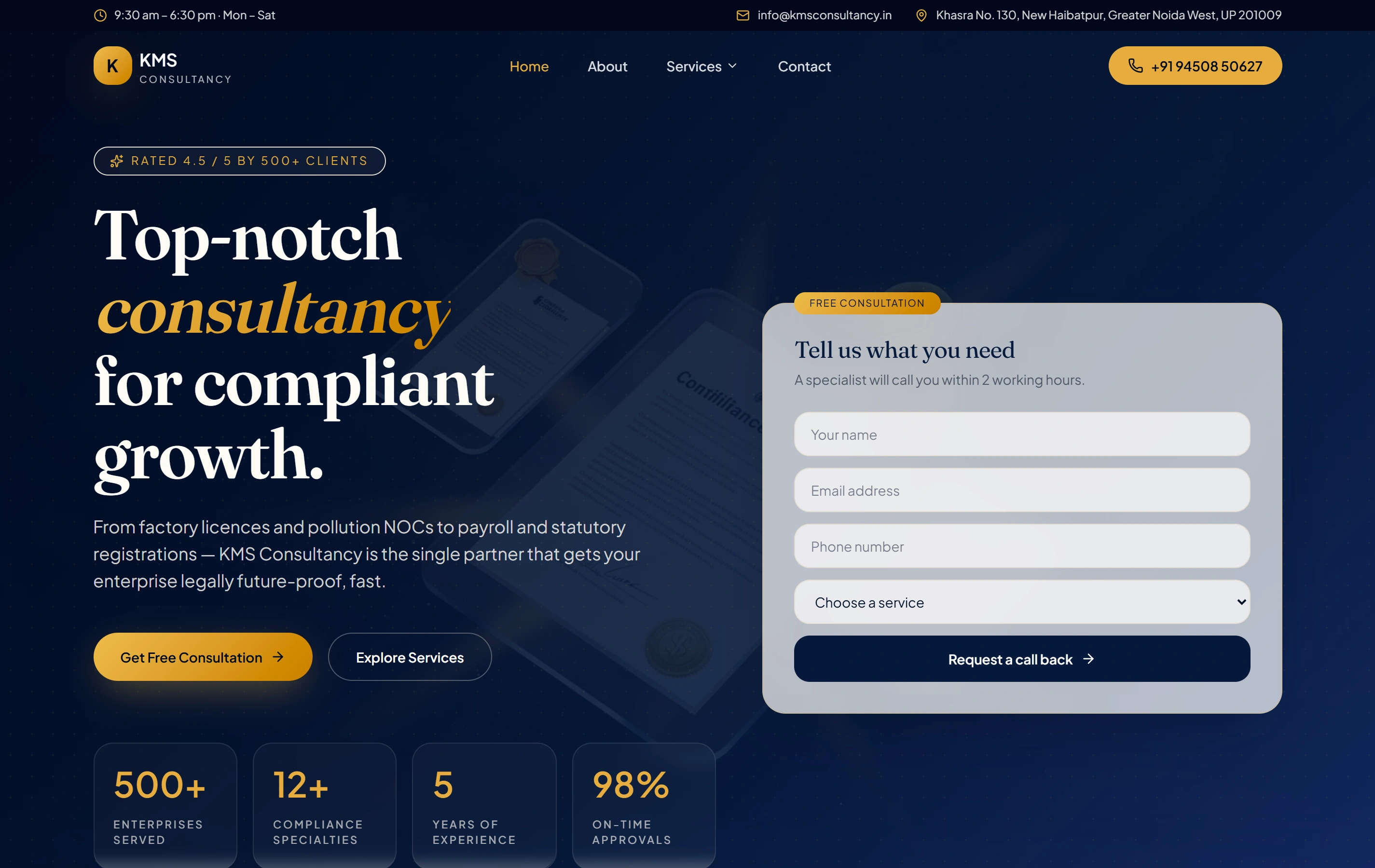
KMS Consultancy is a documented website that organises a complex compliance service catalogue into clear pages and an enquiry journey. This reference illustrates our website design and information structure work. The AI proposal is assessed against your own task, sources and review examples.
No. The useful feature may be a search experience, document-review aid or staff-facing draft rather than a chat interface. We compare these options with ordinary rules and search before choosing the project scope.
We review their quality, ownership, access and supported connections. Representative material helps determine what preparation is needed and which sources belong in the first release.
Ask how the proposed task will be evaluated, what the users can inspect, which dependencies affect the estimate and who will maintain the sources. A working example should help you assess those choices alongside the wider service and handover.
Your team owns the business information and the decisions it supports. The agreement names accounts, technical operation, source updates, issue handling and continuing support so the feature has a practical owner after launch.