Skip to content
Consultancy Website Design for Bengaluru Advisory Teams

Explain the engagement before asking a prospect to describe their problem.

An expertise-led business needs a website that helps a prospective client judge whether the firm is relevant to their question. A long list of disciplines can sound impressive while leaving the visitor uncertain about the engagement, the intended audience and the next step. Softglimmer plans consultancy websites for Bengaluru teams around those practical decisions. We organise approved service information and credible evidence without expanding the firm’s claims. The project is delivered remotely from our Ranchi office, with named reviewers for service wording, design and implementation. Discovery begins with the existing website and the team’s actual approach to qualifying an introductory enquiry.

Explore Bengaluru
Service fit, engagement boundaries and accountable first conversations for consultancies and advisory firms.
  1. 01

    Assess relevance

    Explain the audience and question each service addresses.

  2. 02

    Understand the engagement

    Describe the agreed starting point and boundaries.

  3. 03

    Start a discussion

    Collect proportionate context for a first response.

An example journey, shaped around your requirements.

A hypothetical working example

The prospect recognises a discipline but cannot assess the engagement.

Imagine a hypothetical Bengaluru advisory firm whose website lists many services but uses the same paragraph and contact form for all of them. A prospective client cannot tell whether their business situation fits the offering or what the firm needs before an introductory conversation. This is a working case, not a client account. A clearer website would distinguish the service purpose, the type of engagement and the first enquiry without implying an outcome or professional commitment.

Explain what fit looks like

Describe the approved audience, the question the service helps address and the information needed to discuss scope. Avoid presenting an illustrative process as a guarantee of the same deliverables in every engagement. If services overlap, help the visitor begin with their need rather than forcing them to understand the firm’s internal departmental boundaries first.

Keep the first contact useful

An enquiry can ask for the broad context and a way to respond without collecting every confidential detail. The firm chooses what it wants to receive through the website. The acknowledgement should explain the next conversation and remain distinct from acceptance of an engagement, a completed conflict review or a professional assessment of the situation.

  1. 01

    Assess relevance

    Explain the audience and question each service addresses.

  2. 02

    Understand the engagement

    Describe the agreed starting point and boundaries.

  3. 03

    Start a discussion

    Collect proportionate context for a first response.

Hypothetical planning sequence.

Make the offering specific without enlarging its claims.

01

Review the service catalogue

Gather the firm’s current approved service definitions and compare them with the website. Record differences in audience, engagement type and prerequisites. A service page should explain a real offering, not a new capability inferred from a broad discipline label. The firm approves substantive wording and the boundaries around advice, review or implementation.

02

Use evidence with permission

Identify the projects, credentials or public material the firm is allowed to show. Describe only the role and facts approved for publication. Anonymous examples still need a defensible basis and clear status. Where no publishable client case exists, a labelled hypothetical working example can explain the process without pretending to be proof of prior delivery.

03

Plan the enquiry handover

Agree what an initial request should contain, who reviews it and what happens when it is outside scope. The form needs a purpose that the prospective client can understand. A routing choice should connect to a responsible owner rather than simply attach a service label to the same unmonitored inbox.

04

Keep form wording explicit

W3C’s labels guidance supports identifying controls and associating each label with its field. Apply that principle to the firm’s enquiry wording and review the resulting experience. Required fields, optional context and correction messages should remain clear while entering information; a disappearing placeholder is not an adequate explanation of the business purpose.

A website that supports a considered first conversation.

01

Service and audience brief

Approved service descriptions, the audiences they address and the engagement boundaries that need to remain visible in public copy.

02

Evidence presentation plan

A record of authorised project material, credentials and explanatory examples, with agreed attribution and limits on what each item demonstrates.

03

Qualification journey

A responsive contact flow with proportionate questions, receiving responsibility and acknowledgement wording reviewed by the firm.

04

Content maintenance guide

Instructions for updating service information and evidence, including the reviewer required when a substantive professional claim changes.

Bring service decisions into the website brief.

Collect the current service catalogue, approved firm description and public material used to explain an engagement. The reviewer should identify what may be reused unchanged and what needs a factual update. If the website includes team profiles or qualifications, confirm the wording and publishing permission instead of assuming that a biography from another document is ready for a public page.

Review a few anonymised first-contact scenarios. One prospect may fit a well-defined service; another may have a question that spans several disciplines; a third may be outside the firm’s scope. Determine what the website should explain before contact and what the team will clarify privately. That exercise is more useful than adding a long form that attempts to diagnose every situation before a human conversation.

Agree how a future service or evidence update is approved. A new page can affect navigation, related offerings and contact routing. The website handover should show the editor those relationships and preserve useful existing URLs. Remote review works best when the firm’s service owner validates the substance and the website team presents concrete page journeys to assess. The result is a bounded publishing and enquiry scope, with unresolved dependencies visible before release.

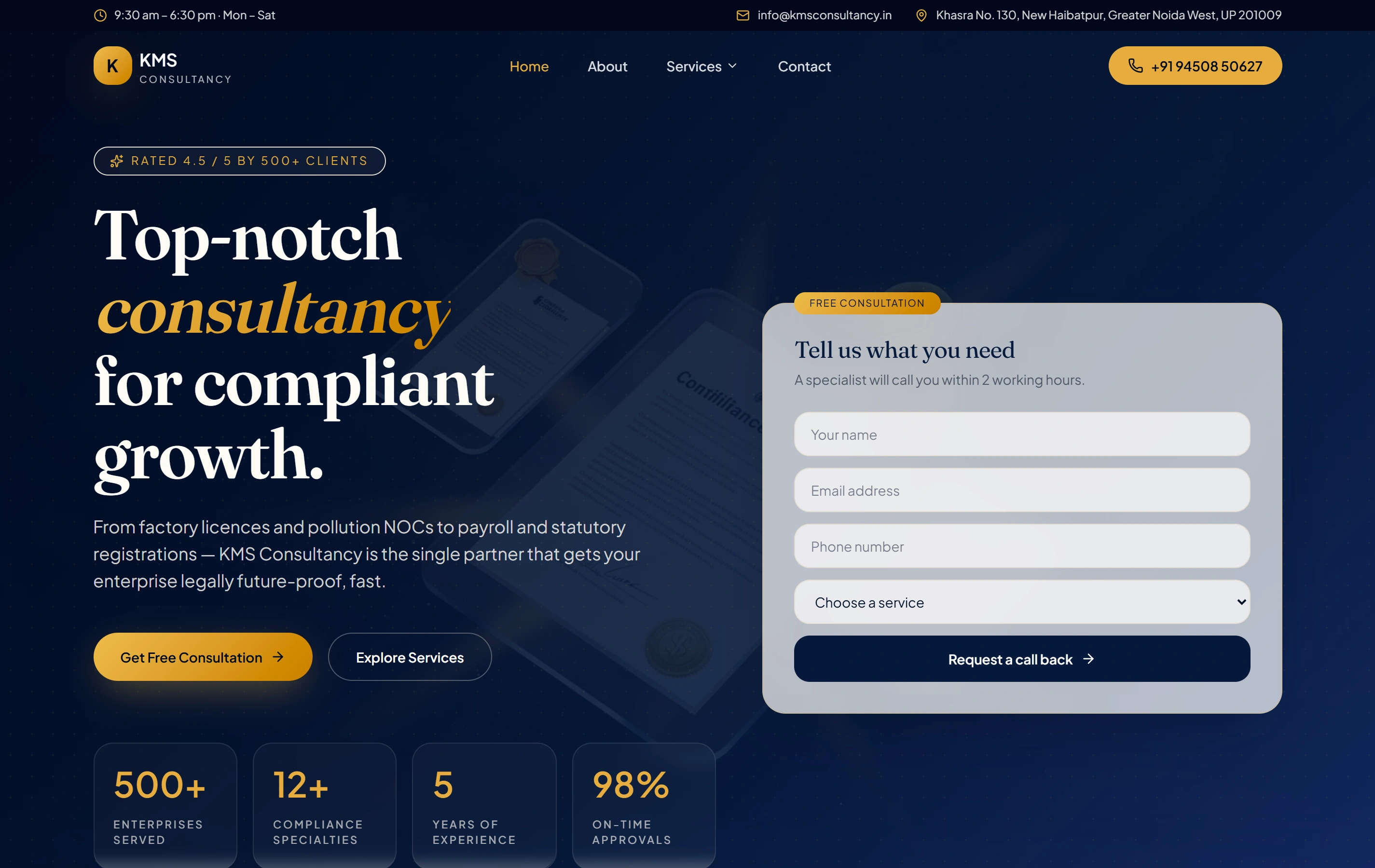
A real consultancy website with a structured service catalogue.

KMS Consultancy is a documented Softglimmer website that organises a compliance consultancy’s service catalogue into clear pages and an enquiry journey. It supports the service-information example here. The portfolio does not establish advisory outcomes, professional credentials or results for a Bengaluru firm, and it does not prove the qualification rules proposed in this guide.

ContentCompliance
StructureService pages
ActionEnquire
KMS Consultancy websiteKMS Consultancy

Questions before commissioning the work.

Can the website qualify every prospect automatically?

The firm should decide what can be assessed from an introductory request and what needs a conversation. We can design clear questions and routing around that boundary. Any automated decision needs a separately reviewed rule, exception handling and an owner; a service-selection field alone is not a complete qualification process.

What if client work cannot be published?

Use the firm’s approved service information and any authorised public evidence. A labelled hypothetical example can explain an engagement question without pretending to be a delivered case. The website should not invent client names, quotations or results to fill a gap in publishable material.

Who approves the Bengaluru consultancy pages remotely?

The firm’s service owner approves the offering and professional claims, while a coordinating contact consolidates design feedback. Our Ranchi team prepares the structure and implementation for review. The decision record separates approved wording from pending evidence or integration questions so the final scope remains understandable.