
Skip to content
Digital Project Planning for Bhubaneswar Organisations

Bring the people who know the offer into the same project decision.

When several people can comment but nobody can settle a question, a digital project loses its direction. For a Bhubaneswar organisation planning a website or business interface, identify the audience, information source and factual approver first. Softglimmer works remotely from its Ranchi studio. We organise discovery around representative content and deliberate review points, with a focused website guide for the public information decisions that follow.

Read the focused guide
A shared project brief that turns several reviewers’ comments into an agreed public information journey.
  1. 01

    Collect the evidence

    Bring the information people already use.

  2. 02

    Resolve the decisions

    Give each open question an accountable reviewer.

  3. 03

    Approve the first journey

    Confirm what the visitor can understand and do.

An example journey, shaped around your requirements.

A hypothetical working example

Three reviewers describe the same programme differently.

Consider a hypothetical Bhubaneswar organisation preparing a public programme website. A coordinator describes the activities, a communications colleague edits the introduction and an administrator answers eligibility questions. Their documents contain different wording. A remote meeting can reveal the conflict, but it cannot determine which description is authoritative without the organisation’s help. The project brief should record the responsible source, the unresolved point and the person able to decide before any wording becomes a public promise.

Use a decision record rather than scattered comments

A comment such as “make this clearer” leaves the next author guessing. Record the passage, the reader’s question, the proposed change and the decision required. Keep resolved comments connected to the approved version. Reviewers can then distinguish a request for factual correction from a preference about layout, and a late participant can understand why a choice was made.
Give the remote review a concrete task

Ask a representative visitor to explain the programme’s purpose and locate the next action using a prototype. Observe where they hesitate instead of presenting every screen as a slideshow. The organisation should decide who can participate, what material may be shown and whether any examples need anonymising. The exercise informs the brief; it does not replace factual approval.

Evidence, decisions and approval
  1. 01

    Collect the evidence

    Bring the information people already use.

  2. 02

    Resolve the decisions

    Give each open question an accountable reviewer.

  3. 03

    Approve the first journey

    Confirm what the visitor can understand and do.

Hypothetical planning sequence.

Organise collaboration around information ownership.

01

Involve the audience early

W3C’s guidance recommends involving people with disabilities early and throughout web projects, alongside standards-based evaluation. For this brief, discuss how representative visitors can review important tasks while the information structure is still open to change. Plan an appropriate range of participants and useful questions; one person’s experience does not establish that the whole website is accessible.

02

Separate the public offer from internal administration

A public website may explain activities and collect an enquiry, while a private tool manages participation. Decide which problem belongs in the initial project. Listing every internal process on the public sitemap makes both journeys harder to explain. The brief should identify any later portal or integration separately, including its account owner and the information it would require.

03

Make review time usable

Bhubaneswar and Ranchi use the India time zone, but matching clocks do not guarantee that reviewers are available together. Agree practical meeting windows and a written response arrangement around the organisation’s working day. Send the evidence and the decision needed before a call. A delayed approval should remain visibly pending rather than being treated as acceptance.

04

Name the maintenance responsibilities

Programme facts, contact instructions and staff information can change after launch. Identify who supplies updates, who approves them and who has publishing access. Include an example of an ordinary correction in discovery. A project is easier to hand over when responsibilities match the recurring work, rather than relying on the original coordinator to remember every informal decision.

A project brief that another reviewer can pick up.

01

Audience and task map

Identify the principal visitor groups, the question each needs answered and the next action the organisation can support. Include one task that crosses between service information and contact. This map helps decide whether the first release needs clearer public pages, an editable content structure or a separate operational interface.

02

Content and approval register

Record the source and reviewer for representative passages, photographs, documents and contact details. Mark material that is approved, waiting for clarification or outside the initial scope. The register gives the design work a factual foundation and reduces the risk that an attractive prototype quietly introduces wording nobody has accepted.

03

Review and handover plan

Describe what will be reviewed at each milestone, the people required and the evidence needed to finish that stage. Include editing demonstrations and ownership of hosting or connected accounts where relevant. Agree the delivery schedule, review responsibilities and ongoing support in the project proposal.

Prepare a discovery conversation with fewer assumptions.

Bring the current site, a representative programme description, usual visitor questions and material shared outside the website. Identify contradictions before treating a document as authoritative. A rough sketch should show the reader’s route as well as visual preferences. Choose a coordinator who can collect feedback and identify the factual approver. Scope missing copy, translation or photography explicitly. Before accepting a release, ask the intended editor to make an ordinary correction and review its public result. That exercise can expose a responsibility the original brief overlooked.

A clearer view of a complex service catalogue.

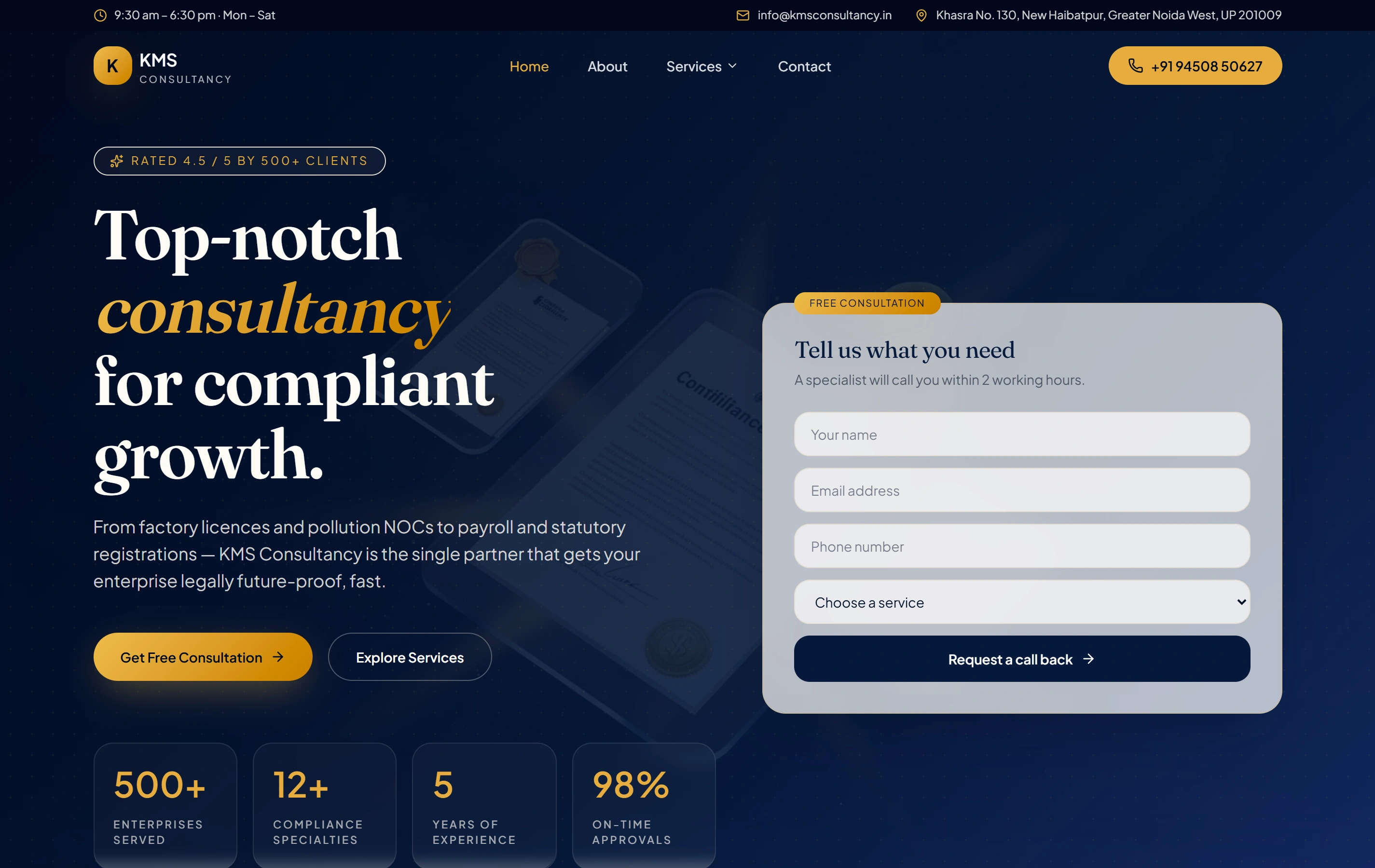
KMS Consultancy’s website organises a complex service catalogue into public pages and enquiry routes. It offers a useful reference for structuring information. For your Bhubaneswar project, the brief would bring together your approved programme content, reviewers and publishing responsibilities.

ContentCompliance
StructureService pages
ActionEnquire
KMS Consultancy websiteKMS Consultancy

Project questions.

Do you have a Bhubaneswar office?

Our studio is in Ranchi, and delivery for a Bhubaneswar team is remote. Reviewers, meeting windows and milestones are agreed for the project.

Must all reviewers attend every meeting?

No. Discovery should identify which person can answer each question and which decisions need a shared discussion. Some feedback can be provided against a written example. A smaller meeting is useful when it produces an authorised decision; excluding a necessary factual owner merely moves the disagreement to a later stage.

Can a website and internal tool start together?

They can be considered in one discovery exercise, but their boundaries and acceptance evidence should remain explicit. A public enquiry does not automatically create a complete administrative record. Decide what the first release must achieve and which connections need separate access, ownership or approval before implementation is proposed.