Identify what is missing
State the business information needed before work can continue. A meaningful waiting reason can help a colleague act; a vague status with no explanation may simply move the uncertainty into another screen.

Softglimmer offers custom business software planning, design and development for Indore organisations from our Ranchi studio. We examine the work, people and records before choosing the application scope. The engagement can include interfaces, agreed connections, data transition and handover, with a useful first release and ordinary operating responsibilities made explicit.
An example journey, shaped around your requirements.
A request for software often begins with a set of forms or reports. Those screens become more useful when the team can explain the responsibility behind them: who starts the work, what information is needed, who can change it and what completion means. We also review whether an existing tool or a focused connection can meet part of the requirement. Where a custom application is appropriate, the brief covers its records, roles, working rules and useful interface states. Selected connections, historic data and continuing support need their own decisions. The proposed application should make an ordinary task understandable, including a legitimate waiting period, rather than forcing every item to appear either untouched or finished.
State the business information needed before work can continue. A meaningful waiting reason can help a colleague act; a vague status with no explanation may simply move the uncertainty into another screen.
Agree who can ask for the missing detail and who can resume the task. The person receiving a response should be able to find the relevant record instead of starting a separate item that loses the earlier context.
A task that is waiting has not necessarily been cancelled or completed. Define the working states and the information they retain. Any report or queue in scope should use those meanings consistently.
Choose the information that permits the next action and who can confirm it. Review a resumed task as well as a straightforward one, including any deliberate changes to its requirements.
Consider a hypothetical team preparing a piece of work that needs one more specification from its customer. This example describes a software requirement; it is not an Indore implementation or a claim about a particular industry.
The team marks the task as waiting, records the missing detail and identifies the colleague following up. The record remains connected to the earlier request. When the answer arrives, an authorised person reviews it and resumes the same task with its useful context available. It is not silently counted as a completed job, and a second record is not created merely because another colleague received the reply.
The acceptance discussion uses a normal task, a waiting one and a resumed one. It asks whether the next colleague can explain the current position without a private message from the previous operator. The chosen implementation still needs the full application scope: permissions, interfaces, data preparation, development, selected integrations, quality review and an operating handover.
The proposal names the selected outputs, the material the business supplies and the responsibilities needed to deliver and use the work.
An agreed workflow, useful initial boundary and comparison with relevant existing tools. Identify the people able to explain business rules and the dependencies needed for the selected release.
Definitions for the information the application holds, who may use it and the tasks each interface supports. Review realistic entries, working states and meaningful exceptions before implementation is treated as complete.
The working functions described by the proposal, with chosen interfaces to authorised systems. Define the source of information, account ownership and what happens when a connection cannot complete its task.
Where earlier records are included, agree preparation, mapping and verification. Review complete tasks with appropriate test material, document findings and confirm the business decision required for release.
The agreed files, access and instructions for ordinary use, with ownership of maintenance and further change requests. Demonstrate the representative task with the person who will operate it.
Share redacted examples of the current records, the useful result and a task that needed more information. Include the people who own the process and the information source. A feature list is welcome, but these examples help reveal rules that a screen title alone cannot explain.
Our remote discovery and reviews from Ranchi can then define a useful application brief for your Indore business. The estimate reflects the selected behaviour, data condition, design work and dependencies. A working public website in the portfolio can illustrate information structure, but a proposed internal application needs its own discovery, implementation and acceptance evidence.
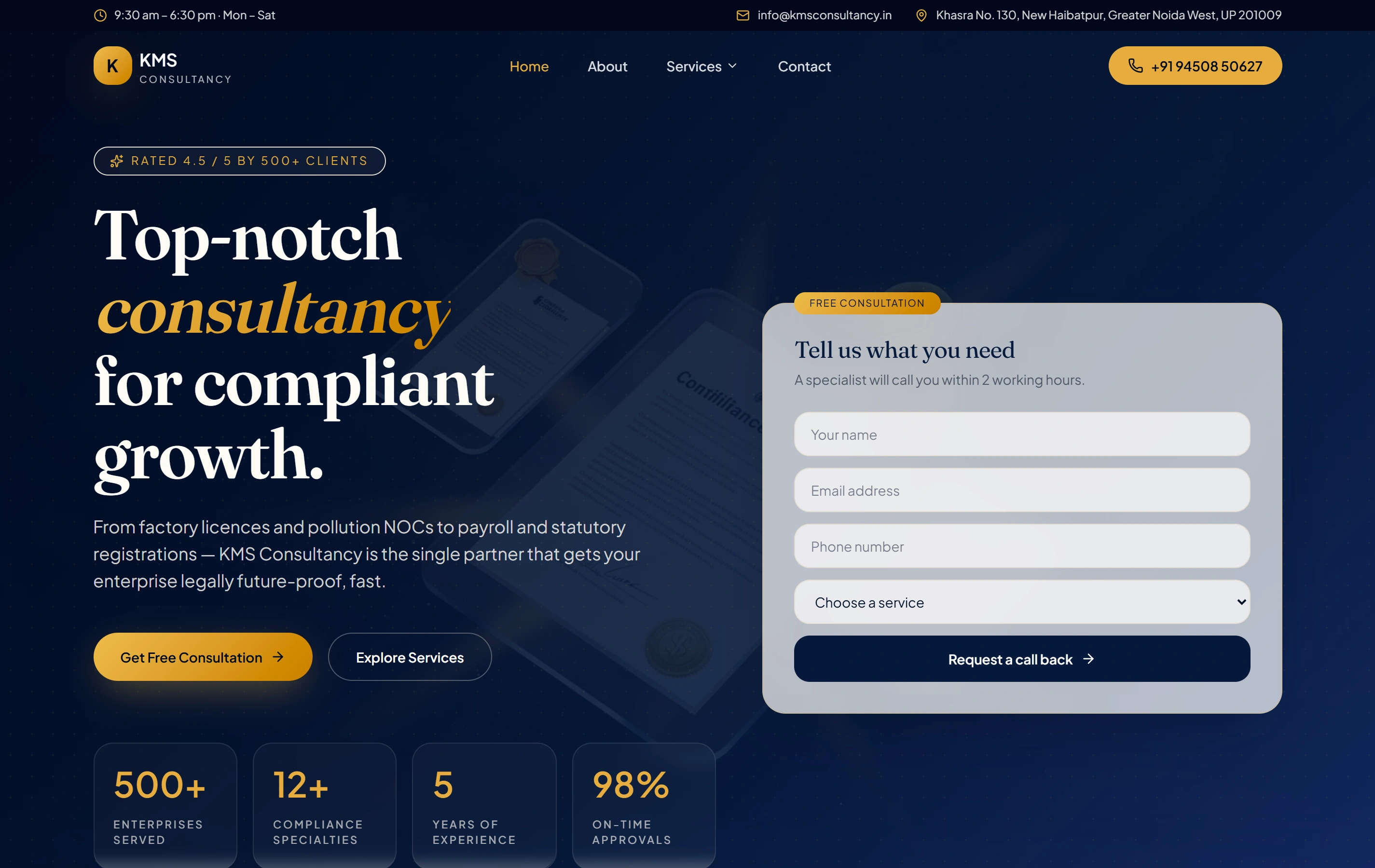
KMS Consultancy is a documented website that turns a complex service catalogue into clear pages and an enquiry journey. It offers a factual public-information reference. It is not proof of custom software, a customer-record backend or the waiting-and-resuming workflow used in this hypothetical service brief.
No. Discovery should identify which current tools remain useful and which gap needs attention. The selected approach may configure or connect existing systems, include a focused custom application or require a wider build. The proposal explains that decision and the responsibilities of each part.
Yes, if it forms a complete useful first release. The brief needs its users, information, working rules, exceptions and operating owner, not only a shortened screen list. Later workflows can be assessed against that initial arrangement without pretending that an incomplete task is ready for ordinary use.