Give the next conversation a clear starting point.
A visitor may understand what you sell yet still be unsure whether you can help with their particular requirement. For a business in Indore, a useful digital brief connects service coverage, current information and the person who will review an enquiry. Softglimmer helps you decide what belongs on a website and what needs an internal process. Our studio is in Ranchi; work for Indore is delivered remotely, with agreed review stages and a business contact responsible for decisions.
Service coverage, useful requirements and accountable business website enquiries.
01
Explain the fit
Show the service and coverage a visitor needs to check.
02
Collect useful context
Ask for enough information to begin a considered review.
03
Own the response
Agree who receives the enquiry and what happens next.
An example journey, shaped around your requirements.
A hypothetical working example
The visitor has a requirement, but the team receives a vague message.
Consider a hypothetical service business with several offerings and different delivery boundaries. Someone asks for a quotation without saying which service they need or where the work will happen. This example is for planning; it is not an Indore client or a claim about the city’s industries. Before commissioning software, examine whether clearer service information and a better initial brief could resolve the uncertainty.
Make the website answer the first question
A visitor should be able to check the relevant offering, important exclusions and the information needed for an initial assessment. An enquiry form can then refer to that context. If coverage changes, identify the colleague who can update it; an attractive page becomes misleading when its service details are stale.
Service coverage, useful requirements and accountable business website enquiries.
01
Explain the fit
Show the service and coverage a visitor needs to check.
02
Collect useful context
Ask for enough information to begin a considered review.
03
Own the response
Agree who receives the enquiry and what happens next.
Hypothetical planning example. Final requirements are agreed with your team.
Decisions before design
Choose the smallest useful starting point.
The brief should describe a working problem before it names a platform.
01
Public information or private work?
Use public pages for information that any prospective customer may need. Private documents, staff assignments and customer records need a separate access decision. A website enquiry does not automatically justify a customer portal or CRM build; explain which follow-up task requires one.
02
One service page or several?
Separate offerings when visitors must make genuinely different decisions. A different headline alone is not a reason to multiply pages. Map each proposed page to a service, supporting evidence and an appropriate next step, then check who will maintain that material.
03
An enquiry or a commitment?
Decide what submitting a brief actually means. A request for review should not look like a confirmed booking, accepted quotation or promise of availability. Write the confirmation message with the person who handles enquiries so customers know what to expect.
An agreed delivery scope
A reviewed route from information to response.
The agreed first phase can be assessed against concrete materials and decisions.
01
A content and responsibility map
A short inventory connects each service page to its source information, evidence and editor. It records details still awaiting confirmation rather than filling gaps with assumed locations, figures or testimonials. The map also identifies who approves changes after launch.
02
A visitor journey to review
A draft journey shows how someone checks service fit, prepares a requirement and reaches the correct contact. Your team reviews the wording and required inputs before development. The selected website scope follows these decisions, including mobile presentation and clear form feedback.
03
A practical handover boundary
Agree the pages, form destination, access ownership and support responsibilities included in delivery. Keep later automation or additional business units in a separate backlog. A named approver can then judge whether the first phase is ready without an expanding feature list.
Prepare the project
Bring evidence of the questions your team actually receives.
A useful first conversation starts with a few ordinary business examples.
Select three different enquiries
Use redacted examples: a suitable requirement, an out-of-scope request and one that needed clarification. Explain which missing detail changed the response. These examples help distinguish information customers need to see from information your team needs to collect.
Check the current service description
Bring the approved names, coverage rules and contact responsibilities. Flag services that are planned but not available. If existing pages are being replaced, include their URLs and useful content so the brief can consider preservation alongside the new design.
Name the reviewer and editor
Choose a person who can confirm business facts and someone who will keep them current. For remote reviews between Indore and Ranchi, agree meeting windows, written feedback and one approval channel. A consolidated decision is easier to act on than conflicting instructions across chats.
Documented website work
Clear service information in a real consultancy website.
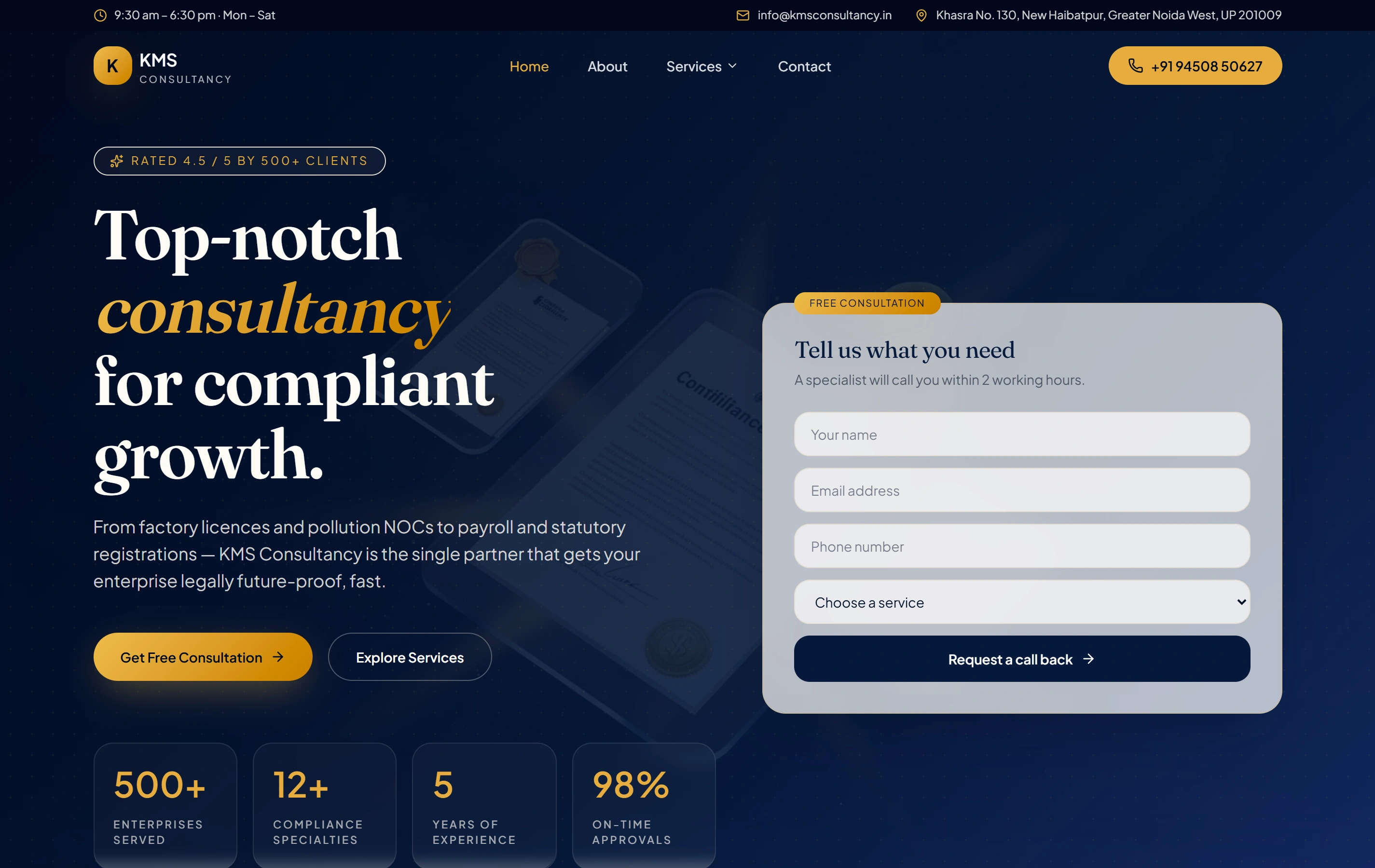
KMS Consultancy is documented on our website as a compliance consultancy project with a structured service catalogue and enquiry journey. The screenshot below shows that website. It is a reference for presenting services clearly, not evidence of an Indore office, a local client or the hypothetical workflow above.
Yes. Softglimmer is based in Ranchi and can deliver remotely for an Indore business. We agree review sessions, the scope and who approves content. This page describes a service area; it does not represent a local office or an established Indore client relationship.
Should we start with a website or automation?
Start with the unresolved task. If customers cannot understand your offering, improve the public information first. If staff lose an enquiry after it arrives, examine the internal handover. Connecting those problems may be sensible, but each needs its own scope and acceptance criteria.
Do we need a page for every place we serve?
Only when a page offers meaningful information for that audience, with truthful coverage and an appropriate next step. A long list of copied place names does not explain the service. We can first document coverage on a clear service page and assess any additional page on its usefulness.
What should we send before an estimate?
Send your existing URL if available, approved service information, a few redacted enquiry examples and the intended owner of replies. Describe which parts work today and which need changing. The scope can then be reviewed before dates, integrations or commercial terms are agreed.
Continue planning
Explore the next decision.
Continue with the guide that fits the work you are preparing.