
Skip to content
Patna · Business Website Design & Development

A business website with clear reasons to connect.

Softglimmer designs and develops business websites for Patna teams, combining content structure, responsive interfaces, CMS editing and practical contact journeys. We work remotely from our Ranchi studio, reviewing the public offer and the receiving team’s needs together. The scope can cover a new website, a focused improvement or a redesign that preserves useful existing material.

Explore the website scope
Useful information before the right conversation.
  1. 01

    Recognise the offer

    Understand the relevant service.

  2. 02

    Choose the purpose

    Find a suitable reason to contact.

  3. 03

    Start the conversation

    Share context with the receiving team.

An example journey, shaped around your requirements.

Commission a complete website, from page plan to operating handover.

The work begins with what the business offers and what its visitors need to decide. We can plan the page hierarchy, develop the visual direction, implement responsive templates and provide the agreed editing controls. Service descriptions, genuine project evidence and contact actions should form one understandable journey rather than separate design exercises.

For an existing website, we review useful URLs, content, photographs and connected functions before proposing replacement. The brief identifies what stays, what changes and who supplies missing facts. A working enquiry form also needs an agreed destination, confirmation wording and a person responsible for responding.

The proposal should make content responsibilities, implementation, review and support explicit. You should be able to assess the website using representative visitor tasks, then maintain its ordinary information through the agreed CMS. Additional CRM or operational software can be considered separately where the public website alone does not address the need.
Choose the website engagement around the actual gap.

01

A first business website

Build an approved explanation of the offer, relevant work and next step. Agree the essential page types and available material before adding pages simply to make the site look larger.

Discuss before build: A clear first public presence.

02

A focused journey improvement

Inspect an existing service or contact journey that visitors find difficult. A clearer page structure, contact choice or mobile form may be useful without replacing the entire website.

Discuss before build: Preserve useful work where possible.

03

A considered redesign

Review the existing content and functions, then plan the new presentation and migration together. Changed URLs, enquiry destinations and editing responsibilities belong in the design brief.

Discuss before build: A visual and preservation scope.

Agree what the website project will deliver.

01

Audience and page structure

Map the services and important visitor purposes to useful pages. Distinguish a genuinely different journey from another label for the same information.

A reviewed page inventory.
02

Responsive visual design

Develop the selected brand direction using real headings, text and images. Review navigation, buttons and readable content on desktop and phone layouts.

A coherent interface system.
03

Service and evidence templates

Present the approved service scope and real project material with context. Identify which facts and media need business approval before publication.

Reusable pages for truthful content.
04

Enquiry and contact functions

Implement the agreed fields, validation, destinations and receipt messages. Clarify when a form is appropriate and when a visible contact alternative is needed.

A demonstrated contact journey.
05

Content editing

Provide the selected text, media, section and navigation controls. Demonstrate an ordinary update and preview with the nominated editor rather than handing over unexplained access.

An editing task the team can repeat.
06

Launch foundations and handover

Review links, metadata, agreed URL handling and the important visitor tasks. Record account ownership, technical upkeep and the support boundary after release.

A launch record with responsibilities.
Illustrative example, not a client case study

An optional example: three visitors need different conversations.

Imagine a business receiving a customer’s service request, a supplier’s introduction and a prospective colleague’s question through one form labelled “Get a quote”. The same fields cannot explain every purpose, and the receiving team has to work out what each message means.

The website could keep a concise general contact page while offering clear routes for the purposes the business actually supports. A service enquiry may ask which work interests the visitor; a supplier introduction may need a different receiving address. Unsupported purposes should not be offered merely to fill the menu.

This is a hypothetical website-planning example, not a Patna client project or a claim about local enquiry patterns. The business defines the supported purposes and recipients. It illustrates a design decision within the wider website scope.

Make contact choices helpful without building a maze.

01

Use labels visitors recognise

Describe the purpose in everyday language rather than exposing internal department names. A visitor should understand the route before entering personal details. Keep a general option where the business can receive and interpret an uncertain request.

Discuss before build: Can the visitor choose without knowing your organisation?

02

Ask for relevant information

Agree the few details that help the receiving team make its first response. Do not present a large combined questionnaire for every purpose. Explain any required attachment process separately where it is actually supported.

Discuss before build: Which answer changes the first response?

03

Verify the destination and receipt

Follow each supported route through validation and confirmation to the agreed destination. The website should acknowledge what happened accurately; submitting an introduction does not establish a quotation, appointment or acceptance.

Discuss before build: Who receives it, and what does the visitor know?

Test the website through several real reasons for visiting.

Review a service page opened directly, a visitor choosing a contact purpose and a person who is unsure which option applies. Use representative test material and the nominated recipients. Check phone reading, keyboard interaction, field errors and the confirmation. Follow the relevant page and destination instead of accepting a homepage screenshot as the complete result.

Ask the editor to change a service description, preview it and review the public result after an approved release. A redesign also needs comparison with the preserved route and content inventory. These tasks provide acceptance evidence for the agreed website; they do not guarantee a particular enquiry count or search position.

Review the business information and the working site together.

  1. 01

    Discover the offer

    Share the present website, visitor questions, genuine work and receiving responsibilities. Identify missing facts before selecting layouts.

    An agreed website brief.
  2. 02

    Design the journeys

    Review representative service and contact pages with actual content. Our Ranchi studio records remote feedback with your Patna decision maker.

    Concrete design decisions.
  3. 03

    Build and demonstrate

    Implement the chosen templates, CMS and functions, then rehearse the important visitor and editor tasks. Resolve release requirements explicitly.

    A reviewable working website.
  4. 04

    Launch and hand over

    Agree the switch, account access, editing guidance and technical support arrangement. Record additional work as a separate considered scope.

    Ownership after launch.

A real website reference with a clear scope.

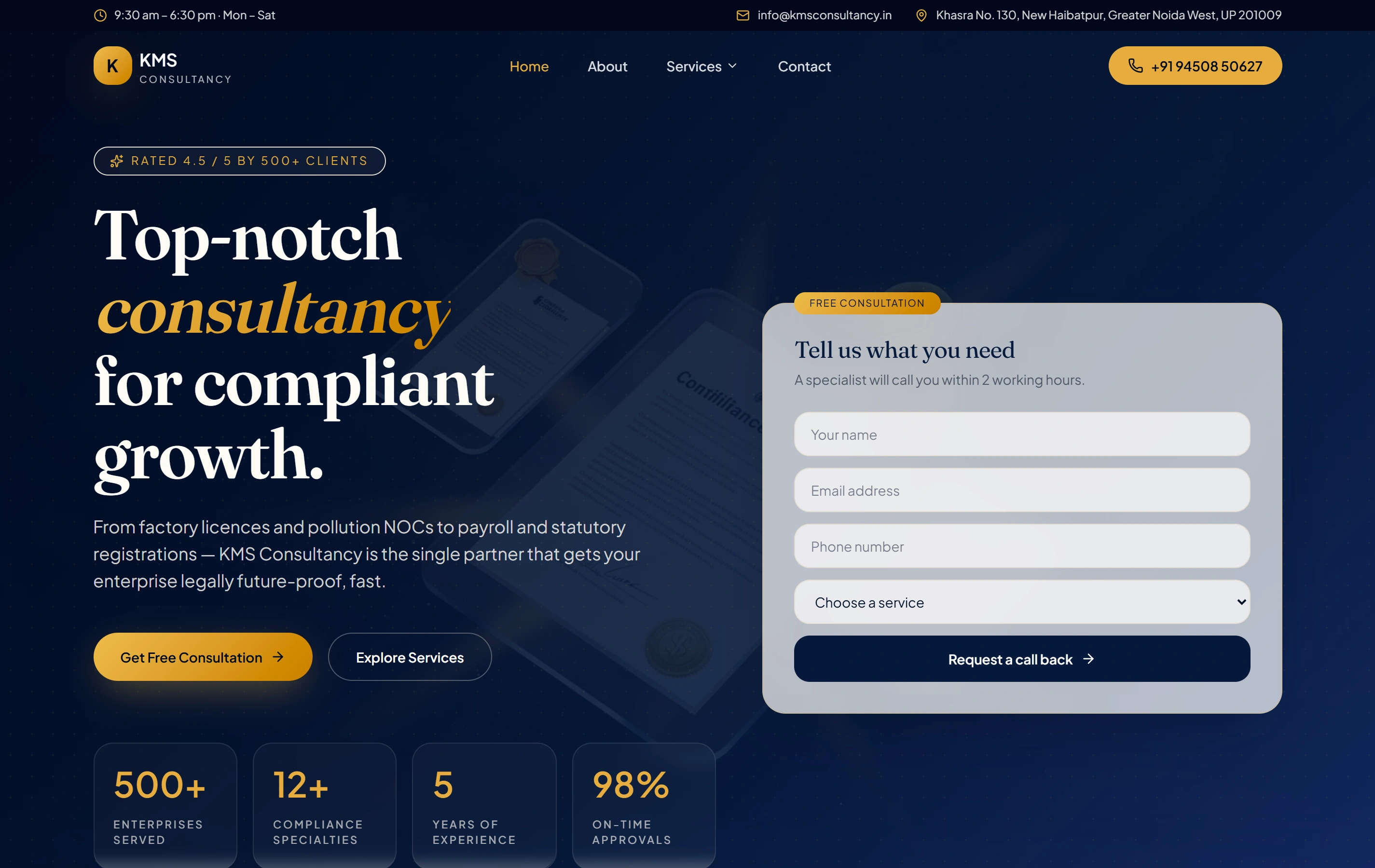
KMS Consultancy is a documented website project presenting a complex service catalogue and an enquiry journey. It offers a real reference for organising service information. It is not evidence that the illustrative contact-purpose design was implemented there, or that KMS Consultancy is a Patna client.

ContentCompliance
StructureService pages
ActionEnquire
KMS Consultancy websiteKMS Consultancy

Questions before commissioning the website.

Can the site use one form rather than separate forms?

Yes, if it handles the supported purposes understandably and sends the necessary context to the correct recipient. We choose from the business’s actual needs. Separate forms are not an objective in themselves, and the interface should not make a simple enquiry harder.

Who supplies the content and project photographs?

The business supplies or approves truthful service facts, project information and suitable media. We can plan the structure and identify gaps within the agreed scope. We do not invent local clients or results, and a photograph’s availability does not establish permission to publish it.

Do you work from a Patna office?

Our studio is in Ranchi. Website planning, design reviews and delivery for Patna teams take place remotely through agreed sessions and written feedback. Any proposed in-person activity would need an explicit separate arrangement; this page does not represent a Patna branch.