The useful first release
Select a coherent working task and the people using it. Name the inputs, decision points and useful result, then identify what may remain outside the initial release. A list of screens does not define the whole process.

Softglimmer offers custom business software discovery, design and development for Mohali businesses through remote work from Ranchi. We begin with the process, shared records and people responsible for the outcome. Configuration or a connection to an existing tool may be appropriate; a custom application is proposed around requirements that justify its implementation and continuing ownership.
Review tasks, shared information and the people making decisions.
Build the agreed records, interfaces and supporting connections.
Review representative work and prepare practical operating guidance.
An example journey, shaped around your requirements.
Describe one task from its beginning to its useful completion, including the information people need and the decisions they are permitted to make. Existing spreadsheets, documents or authorised tools can reveal where information is repeated, difficult to find or easy to misunderstand. We compare retaining, configuring or connecting those tools with a custom build before settling the approach. The agreed application scope can cover record and role modelling, interface design, implementation, selected integrations, migration, acceptance and operating handover. It should explain how people recognise the same piece of work as its description or circumstances change. A record’s editable title, its identity and the meaning of an approval are different requirements. The business decides the rules; the implementation and review make the agreed relationship observable.
Establish which job and related material the correction concerns.
Separate the editable label from identity and approval meaning.
Check the same work and included relationships after the correction.
A hypothetical application acceptance sequence; preservation and permissions need actual implementation evidence.
Select a coherent working task and the people using it. Name the inputs, decision points and useful result, then identify what may remain outside the initial release. A list of screens does not define the whole process.
Establish what each record represents, how staff recognise it and which descriptions can be corrected. Existing references and relationships need an agreed treatment during change or migration, rather than relying on a display name to mean everything.
Decide who may create, review, alter or close the work and what a changed fact means for an earlier decision. The interface and backend responsibilities must be explicit. A tidy prototype is not proof of enforced access or retained history.
Review code or platform ownership, included connections, initial data, environments and acceptance tasks. Agree who administers the result and how technical upkeep, support and further changes are handled after release.
Imagine an ongoing job whose short label is corrected after its purpose is clarified. Staff still need to find the same work, its attachments and the decisions already recorded. Creating another job simply to obtain the new label could split that context; silently treating the label change as a renewed approval could misrepresent a business decision. This is a hypothetical application example, not a Mohali system or a delivered backend claim.
Discovery distinguishes the editable description from the reference staff use to recognise the work. The owner decides whether this correction changes any approved scope and who may make it. The selected interface shows the current description and the relevant context without prescribing a particular database design.
Acceptance follows an ordinary correction using representative records and the intended roles. Inspect the work before and after the change, its included relationships and any affected approval meaning. Implementation evidence, rather than the visual design alone, must establish what the application actually preserves.
The proposal names the selected outputs, the material the business supplies and the responsibilities needed to deliver and use the work.
The included task, roles, important information and approved rules, with unresolved questions and first-release boundaries made visible.
Reviewable journeys using representative records, ordinary changes and useful exceptions, with the intended implementation responsibilities documented.
The agreed application and supporting setup, included integrations and data migration where required. Sources, reconciliation and external-account ownership are named.
Role-based task checks, relevant information reconciliation, business-owned access and practical instructions for administration, recovery and the agreed support arrangement.
Describe the current process and supply sanitised examples of its records, documents and difficult changes. Explain which information is authoritative and who can approve a rule. Avoid sending an entire customer database when a small representative example can establish the question.
Remote Mohali-Ranchi discovery can involve the people who perform and supervise the work. We use their examples to compare the implementation options and propose a written scope and estimate. A useful release includes the receiving operating routine; accounts, migration, maintenance and later development should not be left implicit when the first screens are accepted.
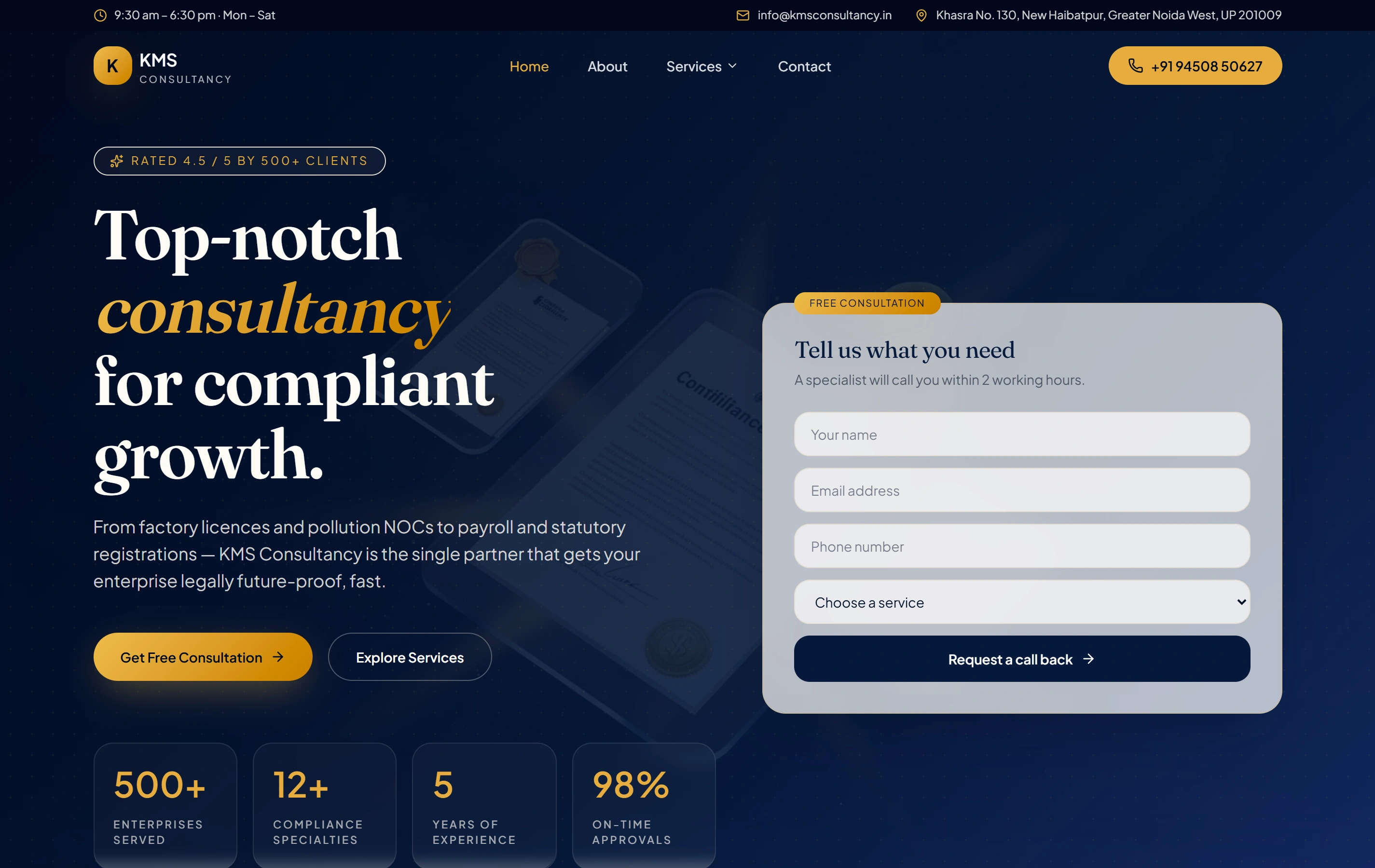
KMS Consultancy is a documented public website for a compliance consultancy, presenting structured services and an enquiry journey. It offers real information-organisation context. The case does not establish delivered operational software, an approval system or the hypothetical Mohali record behaviour described here.
That is one of the options to assess. We review the task, available capabilities, access and operating requirements before recommending the approach. A supported configuration or connection may be sufficient; a custom build needs a clear reason and an ownership plan.
Potentially, after inspecting an authorised sample and agreeing the records, meanings and relationships to retain. The scope identifies preparation, mapping and reconciliation rather than treating a successful import message as proof that the information is correct. Unclear history can remain a visible review item.