From product discovery to the right kind of order.
An online catalogue, a retail checkout and a trade quotation solve different jobs. For a Mumbai business, we start by following how a customer chooses a product and how your team fulfils the request. Softglimmer plans ecommerce websites around that whole journey, with remote delivery from our Ranchi studio and reviews in IST.
Find a useful category, variant and specification.
02
Choose the next step
Buy a standard item or request an appropriate quotation.
03
Fulfil the promise
Give the team an order or enquiry it can act on.
An example journey, shaped around your requirements.
Start with the real task
Start with a real product and a real order.
Before choosing a platform, walk through one standard sale and one difficult exception. A Mumbai retailer selling a ready-to-ship item may need a different journey from a supplier quoting against quantity, specification and availability. The example below is illustrative; it is a planning tool, not a claim about a client or an existing system.
One product, several buying units
Imagine an item sold individually and in packs of twelve. Record the SKU, unit, pack quantity, variant, stock owner and image. If a customer requests forty units, decide whether the website can price that quantity or whether a person needs to confirm a quotation. A clear data model prevents an attractive product page from creating an ambiguous order.
A usable handover to operations
The enquiry should carry the product reference, requested quantity and delivery area to a responsible person. A paid order needs an agreed payment and fulfilment state. Avoid treating a message, an order placed and payment collected as the same event. Your team should be able to explain what happens after each one.
An illustrative catalogue-to-order flow
01
Product record
SKU, unit, variants and approved specification.
02
Buyer action
Standard checkout or a request for a quotation.
03
Team response
Availability, dispatch and exception handling.
Illustrative workflow. The final scope follows your business requirements.
Decisions before design
Which ecommerce scope fits your operation?
The first decision is what the customer can complete without your team. Then we choose a platform and the connections required to support that promise.
01
An enquiry-led catalogue
Suitable when pricing depends on quantity or specification, or availability needs confirmation. Plan categories, product details and a quotation request carrying the selected item. A catalogue should make the buyer’s next step clear without presenting unconfirmed stock or a payment journey your team cannot support.
02
A retail store with checkout
Suitable when product price, stock and delivery rules can be stated consistently. Define variants, cart behaviour, supported payment methods and the information shown before an order is placed. Returns, cancellations and fulfilment responsibilities need an owner as well as a page in the footer.
03
A trade ordering workflow
Consider account-specific pricing or approvals only when there is a documented need. Agree who can see prices, create an order and approve exceptions. Existing ERP or stock tools may remain the system of record; a connection needs explicit identifiers, direction, error handling and a reconciliation process.
Choose the selling model.
Use these distinctions to make the scope and responsibilities reviewable.
Illustrative planning comparison; confirm the decisions for your business.
Decision
Enquiry catalogue
Retail checkout
Trade workflow
Customer action
Send the item and required quantity for a quotation.
Select a priced variant and place an order.
Request or place an order under agreed account rules.
Before launch
Approved product facts and a quotation owner.
Confirmed price, stock, payment and fulfilment rules.
Defined accounts, price visibility and approval states.
Exception to review
A request with an unusual unit or specification.
Unavailable stock or a delayed payment result.
Conflicting updates or a changed customer permission.
A reviewable scope
A practical ecommerce deliverable list.
The agreed scope should name the journeys and records you receive, rather than promising a store with every possible feature.
01
Catalogue structure
A category and product model with a sample import, variant rules and an image checklist. Review examples that include missing information and discontinued products so your team knows how to maintain the catalogue after launch.
02
Buying and enquiry paths
Responsive product, cart or quotation journeys matched to the selling model. Confirm what the visitor sees after submitting a request, how a team member receives it and how a failed action can be retried safely.
03
Operational connections
A written map of stock, orders, payment status and fulfilment tools included in the project. Define which system owns each record. Scope the handling of delayed updates and provider failures before relying on an automated connection.
04
Launch and ownership record
A record of account owners, approved policy copy, redirects where needed, checks completed and handover instructions. Platform subscriptions, payment fees and ongoing support are discussed separately so ownership and running costs remain understandable.
Prepare the brief
Use these scenarios to review the launch.
Bring a small, representative product file and agree expected behaviour for each scenario. These examples help a retailer or supplier assess the build without needing to read its code.
The selected variant becomes unavailable
Check how availability changes between product selection and the final action. Confirm what the customer sees and whether an enquiry can be offered instead. Decide who repairs an incorrect stock record and how existing orders are handled.
A payment result is delayed
A customer returning from a payment page should not be told payment succeeded without the provider’s confirmation. Review the pending state, follow-up and reconciliation process. Use agreed test modes and review responsibilities before enabling live transactions.
A trade buyer requests a different quantity
Test a quantity that does not match the normal pack. Check that the item, unit and requested quantity stay attached to the enquiry. Confirm who provides the quote and where any negotiated price is recorded.
A product URL changes
List existing URLs before a catalogue migration, map the replacements and check important internal links. Give product and category pages descriptive titles, useful copy and suitable images. Sitemap inclusion supports discovery but does not establish indexing or a particular search position.
From brief to handover
Build from product data to a reviewable release.
We agree responsibilities with your Mumbai team and keep the delivery plan visible through remote reviews. The schedule follows catalogue readiness, integrations and the approved scope.
01
Agree the model
Review products, buying units, audience and the exceptions your staff handle today. Choose a catalogue, checkout or trade workflow and identify the first release’s boundaries.
02
Review the journeys
Approve sample product pages and the mobile buying or quotation path. Test the words, information and decisions before extending the layout to the full catalogue.
03
Connect and check
Implement the approved operational connections and run the agreed scenarios. Record unresolved items, account ownership and the release conditions; avoid hiding them behind a launch date.
04
Launch and hand over
Check the public journeys, content editing and operational handover. Agree monitoring and support responsibilities. Later improvements follow observed customer and team needs rather than an unverified sales promise.
Questions before you commission the work.
Useful answers about scope, ownership and remote delivery.
Do you have a Mumbai office?
Our studio is in Ranchi. We work remotely with Mumbai businesses, share review links and coordinate in IST. We do not present a remote service area as an office address.
Is this the same as your Mumbai Shopify guide?
This guide helps choose between a catalogue, checkout and trade ordering scope. Our separate Shopify guide covers planning a Shopify storefront once that platform is an appropriate fit. We connect the guides rather than repeat the same platform page.
Can we keep our current inventory system?
Often that is a useful starting point. We inspect available access, identifiers and integration capabilities before agreeing a connection. Keeping an existing system does not mean its data can be synchronised without clear ownership and exception rules.
What does an ecommerce website cost?
The quotation depends on catalogue size and quality, buying journeys, platform, integrations and migration needs. Share representative products and operating rules so we can provide a defined scope. We do not invent a fixed price before reviewing those requirements.
From our actual portfolio
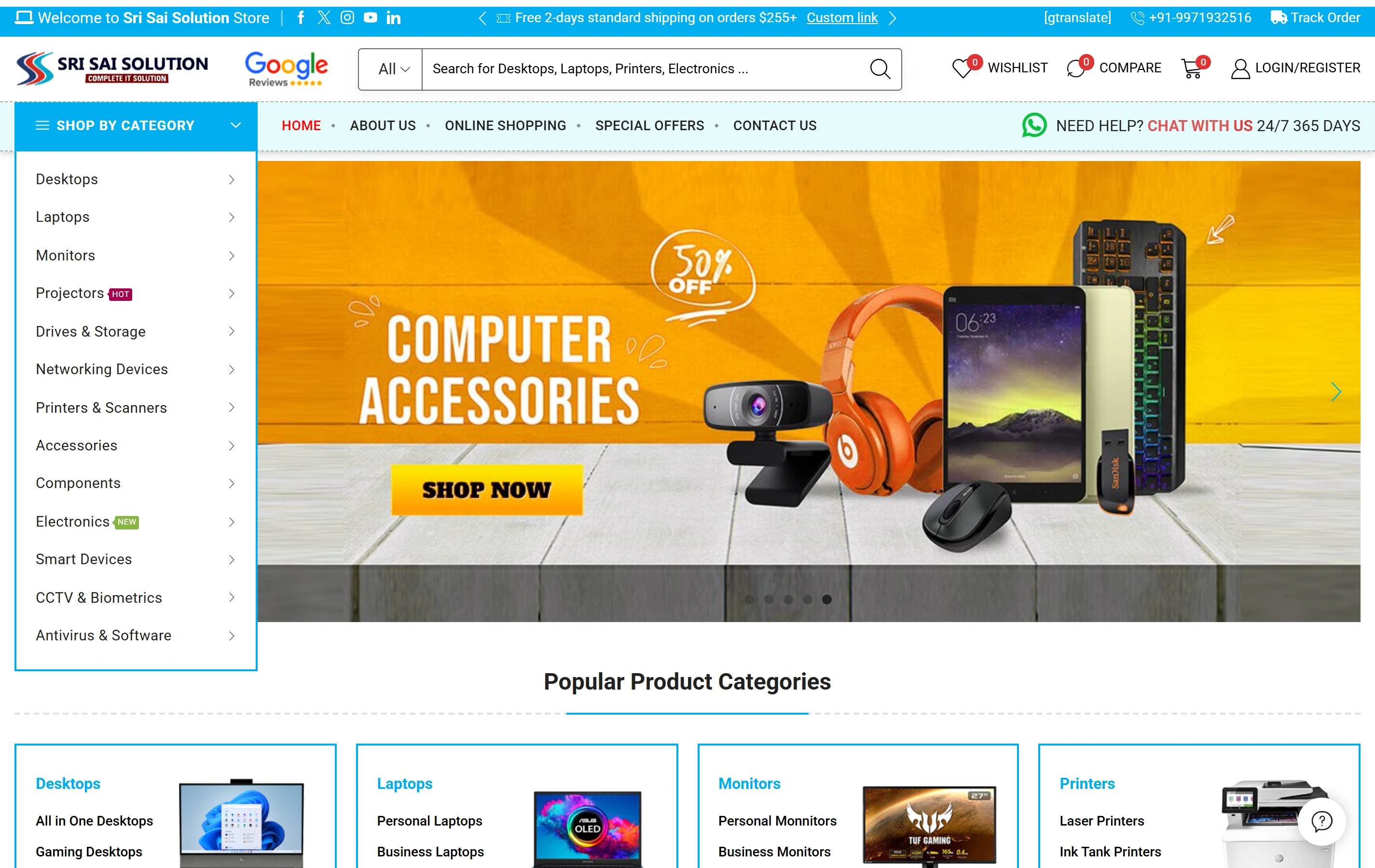
A real retail catalogue you can explore.
Our Sri Sai Solution website project brings retail products into a public catalogue. Explore the project as a starting point for your own product presentation.