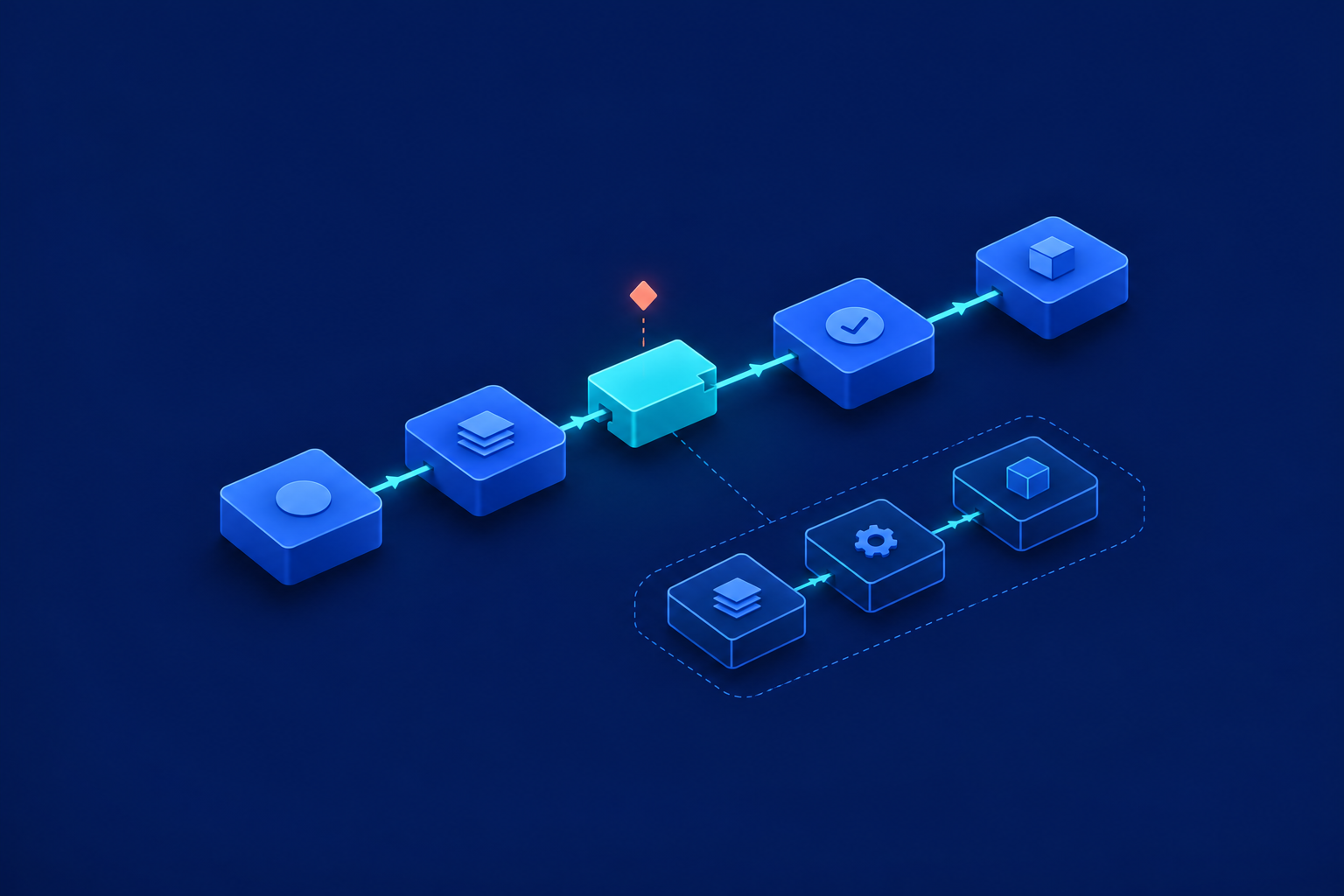
CRM lead stages should describe evidenced progress towards a purchase, not merely tasks completed by salespeople. A confirmed requirement can justify moving forward; calling twice cannot. Separate enquiry qualification from deal progress, and keep invoices and collections on another track. For every stage, define the evidence required, one accountable owner and the next action.
Separate the relationship, enquiry, purchase and payment
A company can be an established customer, have an unqualified new enquiry and owe money on an earlier order simultaneously. One status cannot express all three. Keep the customer relationship intact and create a separate enquiry or purchase record. Repeat business should not reset relationship history.
| Record or field | Question it answers |
|---|---|
| Contact/company relationship | Who is this buyer, and how do we know them? |
| Lead status | Is this enquiry genuine and worth pursuing? |
| Deal stage | How far has this particular purchase progressed? |
| Invoice/payment status | What has been billed, received and left unpaid? |
Vendor labels need care. HubSpot distinguishes contact/company lifecycle stages, Lead Status within its Sales Qualified Lead lifecycle stage, and a separate lead-object pipeline. These are not interchangeable concepts.[1] The model below is adaptable operating guidance, not a requirement to reproduce any vendor’s defaults.
Before a deal exists, qualify the enquiry
Create a deal when there is an identifiable purchase, a fit with your offering, a plausible buying route and an agreed next step. A phone number alone is insufficient. Lead statuses can remain simple; their purpose is to distinguish work awaiting qualification from purchases worth actively managing.
| Stage | Entry evidence | Accountable owner | Next action |
|---|---|---|---|
| New enquiry | Distinct enquiry with a usable contact route. | Enquiry owner | Check duplicates; set first-contact task. |
| Attempting contact | Actual attempt recorded; no two-way discussion. | Enquiry owner | Schedule the next attempt. |
| Connected | Two-way exchange confirms a genuine enquiry. | Sales owner | Establish need, fit, timing and buying route. |
| Qualified | Specific purchase fits; buying route and next step agreed. | Sales owner | Create or link the deal; transfer evidence. |
| Disqualified | Evidence establishes unsuitable fit or no genuine enquiry. | Enquiry owner | Record reason and close qualification. |
Attempting contact is a useful work status, not evidence of buyer progress. Keep that distinction out of deal forecasting. For genuine but premature enquiries, use a revisit flag, review date and trigger, such as the buyer’s next budget round. Do not leave them active indefinitely or reject them simply because timing is early.

Build deal stages around buying decisions
| Stage | Entry evidence | Accountable owner | Next action |
|---|---|---|---|
| Requirement confirmed | Buyer-confirmed scope, quantity, location and timing. | Sales owner | Resolve gaps; prepare the offer. |
| Quotation submitted | Identified quote version sent to the buyer. | Sales owner | Confirm receipt; arrange review. |
| Buyer evaluation | Buyer confirms active review and a decision step. | Sales owner | Resolve objections; confirm decision timing. |
| Order confirmation pending | Buyer indicates intent; a defined acceptance requirement remains. | Sales owner | Obtain the missing commitment evidence. |
| Closed won | Documented order-acceptance rule satisfied. | Sales owner | Record accepted value; hand over to finance and operations. |
| Closed lost | Purchase ended or documented inactivity rule reached. | Sales owner | Record reason, evidence and any revisit date. |
Write the won rule explicitly. It might require an accepted purchase order and internal approval; another business might require an advance before accepting work. Neither means full payment. Similarly, sending a quotation does not prove active evaluation. Require buyer confirmation before moving into that stage.
More stages can reveal bottlenecks but also add administration. Merge stages that trigger identical actions. Add a gate for a material decision, such as mandatory sample approval. Allow evidence-based skipping for straightforward repeat orders. Keep follow-up tasks and due dates outside stage names, and permit backward movement when a requirement genuinely changes.
Record disqualification and lost reasons honestly
Disqualification means an enquiry never met your pursuit criteria. Closed lost means a qualified purchase did not proceed. Mixing them distorts win/loss analysis. Require one primary reason and a factual note. For example: delivery constraint; buyer needed dispatch before our available production slot.
- Fit or delivery: Outside the offering, service area or achievable delivery window.
- Budget or terms: Funding unavailable or specified commercial terms rejected.
- Competitor: Buyer confirmed another supplier was selected.
- Cancellation or deferral: Purchase cancelled or postponed; record a credible review date where available.
- Exhausted follow-up: The documented contact process ended without a response.
- Unknown: The reason was not confirmed.
Never translate silence into a price objection. Keep duplicates, spam and test records outside commercial loss reporting. A deferred deal should leave the active forecast unless a current buying process remains evidenced. A future review date preserves the opportunity to reconnect without pretending the sale is progressing today.
Separate accepted orders from collections
Deal value is not a receipt. HubSpot’s deal Amount describes total deal value; its Closed amount concerns closed-won value, not money collected.[2] Stripe’s partial-payment documentation separately describes remaining invoice balances and full payment.[3] These distinctions support separate sales and collections reporting; they do not establish feature availability for every account.
| Measure | Definition |
|---|---|
| Accepted order value | Accepted scope on a stated tax-inclusive or tax-exclusive basis. |
| Invoiced amount | Valid invoices linked to that order. |
| Allocated confirmed receipts | Verified customer payments assigned to those invoices. |
| Credits or adjustments | Recorded corrections, reductions or reversals; never hidden in receipts. |
| Invoice balance | Unpaid issued-invoice amount after applicable receipts and adjustments. |
| Unbilled order value | Accepted scope not yet invoiced. |
| Collection status | Payment state, with overdue flags based on applicable due dates. |
Sales owns acceptance evidence and order value. Finance owns invoice allocation, verified receipts and due dates. Operations owns fulfilment. Also distinguish a confirmed customer payment from a payment provider’s later bank settlement. Name both measures clearly, account for fees separately and reconcile them rather than calling both cash collected.
Hypothetical example: an accepted order, partly paid
A fictional Pune industrial supplier receives a components enquiry. The buyer confirms specifications, quantity and delivery location. Fit, purchasing approval route and a quote-review meeting establish qualification. A quotation follows; the buyer confirms active evaluation. The purchase order then arrives and passes internal acceptance. That evidence supports closed won. All following amounts are assumed, use one consistent basis and omit tax.
| Measure | Amount or status |
|---|---|
| Accepted order value | ₹2,00,000 |
| Invoiced amount | ₹2,00,000 |
| Confirmed receipt allocated | ₹60,000 |
| Invoice balance | ₹1,40,000 |
| Remaining-payment due date | 10 November 2026 |
| Sales stage | Closed won |
| Collection position | Partially paid; remaining balance not overdue |
Report ₹2,00,000 accepted and ₹60,000 received, not ₹2,00,000 collected. If only a ₹60,000 advance invoice had been issued and paid, that invoice would have no outstanding balance. The other ₹1,40,000 would be unbilled accepted scope, not automatically invoice debt. Finance should confirm the correct invoicing and tax treatment for the actual transaction.
Turn the definitions into a one-page team agreement
- Test recent cases: Walk representative enquiries, losses and accepted orders through the worksheet.
- Remove duplication: Merge stages where evidence and next actions are identical.
- Check support: Confirm permissions, plan entitlements, available fields and links between customer, deal and invoice records.
- Test required information: Check each way records are created or changed, not just the normal sales screen.
- Review regularly: Check missing actions, stale deals, reason quality and sales-to-finance reconciliation.

Do not assume every route enforces the same rules. HubSpot documents conditional stage properties for manual creation and stage changes; custom lead pipelines do not inherit default lead-stage automation.[4] Agree the operating model first. The related guide Before automating leads, agree what happens next covers the broader handoff checklist.
Common stage decisions
Does every existing-customer enquiry need a deal?
No. Preserve the customer relationship and qualify the new purchase separately. Create a deal when it meets your agreed pursuit criteria.
Can we skip stages?
Yes, when evidence satisfies the later stage’s entry rule. An acceptable repeat-order purchase order may justify moving directly to won.
Can an order be closed won after only an advance?
Yes, if your acceptance rule is met. Keep the full accepted value and record the advance separately. Won does not mean fully collected.
Start with one worksheet session involving sales, finance and operations. Test the definitions before changing the system. If the existing CRM cannot represent the agreed rules, read Does your team need a custom CRM? Softglimmer Services can help map the workflow before you decide what needs changing.
Sources & further reading
Use the original guidance when checking details or planning implementation.
This research-assisted guide uses the primary sources linked above. Examples are illustrative unless explicitly identified otherwise. Check original documentation when implementing changes.