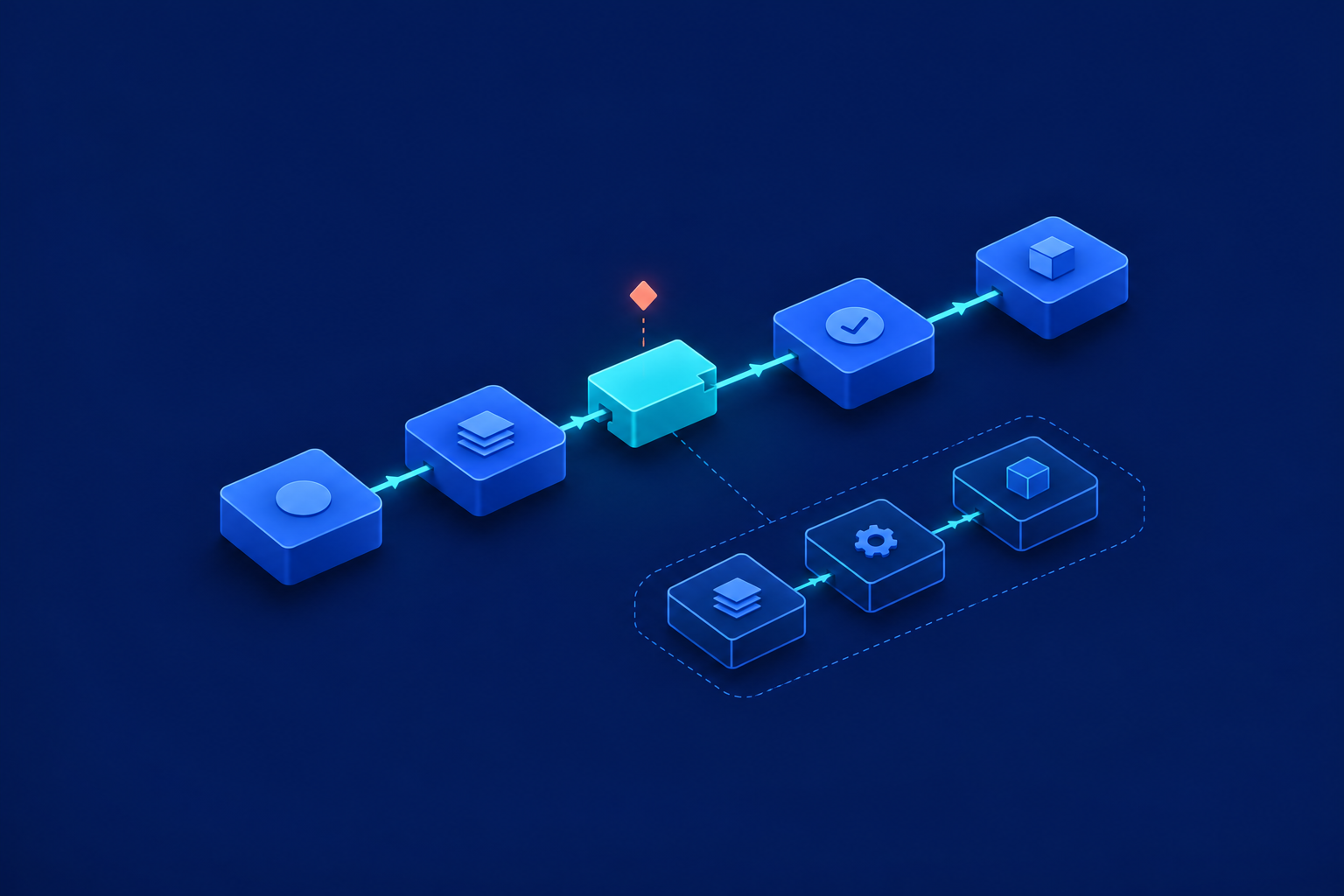
Count a website enquiry when your business has validated and safely saved it, not when someone clicks a contact button. Then record qualification and sales outcomes separately. Useful website conversion tracking connects three records: website activity, confirmed receipt and commercial outcome. Those totals answer different questions, so they should not be combined into one conversions figure.
Agree what deserves conversion status
Use a measurement contract: a shared definition of each action, its evidence, counting unit and owner. Keep contact clicks and submission attempts as diagnostic activity. A WhatsApp click does not prove a conversation happened; a phone-link click does not prove anyone answered. Calls and messages become received enquiries only when a genuine request is recorded.
| Action | Evidence | Counting rule | Owner |
|---|---|---|---|
| Contact click | Phone, email or WhatsApp link selected | Each interaction; diagnostic only | Marketing |
| Submission attempt | Form submission attempted | Each attempt; diagnostic only | Website partner |
| Received enquiry | Validated request durably saved | Once per accepted submission ID | Operations |
| Qualified enquiry | Sales confirms agreed fit criteria | Once at first qualification per enquiry | Sales reviewer |
| Opportunity | Specific potential sale being pursued | Once per opportunity ID | Sales |
| Won deal | Agreed commercial completion condition met | Once per deal ID | Sales |
Google documents separate lead events, including generate_lead, qualify_lead and disqualify_lead. These names do not establish your business rules or automatically assess suitability. Our recommendation is to trigger generate_lead after confirmed receipt, rather than on a button click. That trigger choice is an editorial recommendation, not a Google requirement. [1]
Confirm receipt before checking notification delivery
Agree this sequence with your website partner: validate, save durably, confirm receipt, notify staff, then review. A notification failure should not remove the saved enquiry. Keep a submission ID, receipt timestamp, CRM-recording status and notification email ID separately. This lets operations find a request even when its email never reaches the intended person.
Resend distinguishes a successful send request from delivery to the recipient’s mail server. Its email.sent event means the request succeeded and delivery will be attempted; email.delivered means the receiving server accepted it. Neither proves inbox placement, human reading or sales follow-up. A delivered notification is therefore evidence about communication reliability, not lead quality. [2]
Expect consent-related measurement gaps
Google Consent Mode changes tag behaviour according to consent choices; it does not obtain consent. In basic mode, Google tags remain blocked until consent, and no data is sent to Google when consent is denied. Advanced mode can send cookieless measurements while storage consent is denied. These are materially different designs, not interchangeable settings. [3]
Basic mode offers a clearer no-transmission boundary before consent, but leaves larger observational gaps. Advanced mode provides additional measurement signals, with different privacy considerations. Neither establishes legal compliance. Keep operational enquiry handling, analytics and promotional messaging as separate purposes. Exclude names, email addresses, phone numbers and enquiry text from ordinary analytics parameters and tracking URLs.
Let sales define and record qualification
Choose practical criteria: relevant service, serviceable location, genuine need, reachable contact and an agreed next step. Name a reviewer and record the decision, reason and stage-transition date. Keep awaiting review, clarification pending and disqualified separate. Missing information is not proof of poor fit. Record changes to qualification rules so comparisons do not disguise a changed definition.
HubSpot distinguishes lifecycle stages, which describe the broader customer relationship, from Lead Status, which describes sales sub-stages within Sales Qualified Lead. Its Opportunity stage involves a deal association. Our proposed operating model is not an exact HubSpot configuration: track contacts, enquiries and deals separately, starting with manual review if needed. Several contacts or enquiries may contribute to one deal. [4]

Treat attribution as recorded credit, not cause
Keep first-user source, enquiry-session source and self-reported discovery separate. Google distinguishes first-user acquisition from session acquisition; they answer different questions. Event totals also differ from conversion credit distributed under an attribution model. Label which measure you are using rather than presenting all three as the source of the sale. [5]
Someone might discover your service through search, receive a colleague’s recommendation, then return directly to enquire. The final recorded visit does not establish what caused the sale. Cross-device journeys, offline conversations and consent gaps limit visibility. Preserve unknown sources. Qualified enquiries with recorded paid-search source is a defensible description; enquiries caused by paid search requires stronger evidence.
Hypothetical example: reconcile different but valid totals
Consider a fictional Pune industrial pump-maintenance business. These invented figures are neither client results nor benchmarks. It reviews enquiries received during September 2026, with outcomes checked on 27 October 2026. Basic Consent Mode is an example assumption, not a universal prescription. Qualification requires a relevant industrial need, serviceable site, reachable contact and concrete next step.
| Measure | Count | Meaning |
|---|---|---|
| Contact clicks | 90 | Interactions, not confirmed conversations |
| Submission attempts | 50 | Includes failures and retries |
| Unique saved enquiries | 40 | Confirmed operational receipts |
| Consented browser lead events | 30 | Analytics-observed receipts |
| Delivered notifications | 38 | Two of 40 sent notifications need investigation |
| Qualified enquiries | 16 | Fit confirmed by sales |
| Disqualified enquiries | 8 | Reasons recorded |
| Clarification pending | 10 | Not yet a qualification decision |
| Awaiting review | 6 | Sales assessment outstanding |
| Opportunities | 8 | Eight qualified enquiries each linked to one opportunity |
| Won deals | 3 | Three opportunities won by the review date |
Qualification so far is 16 ÷ 40 = 40%. Opportunity progression among qualified enquiries is 8 ÷ 16 = 50%. Both use the same receipt cohort: the group received during September. It remains immature because sixteen enquiries still need review or clarification. Clear that backlog before treating the current qualification rate as a final judgement on acquisition quality.
Build three dashboards with different decisions
| Dashboard | Include | Action supported |
|---|---|---|
| Receipt and reliability | Attempts, saved receipts, duplicates, CRM gaps, notification failures | Investigate missing records and communication failures |
| Sales quality and follow-up | Pending review, qualification reasons, owners, first-response time, opportunities and wins | Clear backlogs and improve handling |
| Acquisition quality | Received and qualified enquiries by recorded source, unknown share, actual campaign spend where available | Review spending against evidenced enquiry quality |
Every dashboard needs a counting unit, date basis, cohort review date, attribution rule, measurement coverage and last-updated time. Separate receipt-date cohorts from stage changes this month. Keep pipeline value, booked sales and cash collected distinct. Manual register and CRM reconciliation is a valid starting point; more automation is not a prerequisite for useful reporting.
Start with a one-page measurement agreement
- Define: write each measure’s definition, evidence source, counting rule, owner, review cadence and decision supported.
- Test failures: invalid forms must not create received enquiries; valid saved requests must remain accessible.
- Test retries: repeated delivery of the same request must not inflate the receipt register.
- Test notifications: a bounce must remain visible without deleting the enquiry.
- Test consent: check acceptance, rejection and changed choices against the selected measurement design.
- Test delayed outcomes: qualify an older enquiry and confirm its receipt cohort and transition date remain distinguishable.
- Reconcile weekly: compare saved enquiries, CRM records, notification exceptions and outstanding sales reviews.

Next, take one week of enquiries and reconcile them manually with marketing, sales and your website partner. Use Before automating leads, agree what happens next for handoff decisions, and Does your team need a custom CRM? for system choices. Automated CRM synchronisation, offline uploads and advertising feedback sit outside this guide and require their own operational verification.
Should contact-button clicks be conversions?
Keep them as diagnostic interactions unless your report explicitly measures contact intent. For enquiry reporting, require evidence of a saved request or recorded conversation. Otherwise, a click can look like demand that sales never received.
How should repeat submissions be counted?
Count retries of the same request once. Count genuinely separate requests as separate enquiries, even when they come from one contact. Count opportunities and won deals by their own IDs so multiple messages about one sale do not inflate commercial outcomes.
Which number should guide marketing spending?
Review qualified enquiries and opportunity progression by recorded source, alongside actual spend and pending-review volume. Check coverage and cohort maturity first. Cheap clicks or abundant submissions are not enough when sales cannot confirm suitable demand.
Sources & further reading
Use the original guidance when checking details or planning implementation.
This research-assisted guide uses the primary sources linked above. Examples are illustrative unless explicitly identified otherwise. Check original documentation when implementing changes.